Research for Designers: A Guide to Methods and Practice

good-design-award_gold-winner_rgb_blk_logo
  • 2026

  • Design Research

Designed By:

Commissioned By:

SAGE Publications

Designed In:

Australia

“Research for Designers: A Guide to Methods and Practice” is the gold standard for design research, bridging academia and industry for students and professionals. Taught at 500+ universities across 155 countries, used by Fortune 100 companies and governments worldwide, the book’s influence has been transformational for the field of design.

view website
Buy online

2.jpg
3.jpg
  • CHALLENGE
  • SOLUTION
  • IMPACT
  • MORE
  • I was commissioned to write a book for teaching design research — a process that itself required design research. When my work began in 2010, this was still a fringe field. There were no standardised resources for teaching designers how to ask the right questions or conduct empirical and evidence-based research. As design started to intersect with social, economic, cultural, and environmental sectors, the need for this kind of knowledge continued to grow. Designers were increasingly being asked to address issues they lacked the frameworks and research skills to properly investigate, define, or resolve. I was asked to bridge this gap.

  • Once published in 2015, “Research for Designers” became the first work to standardise how empirical, evidence-based research could be taught and applied in design. The content was developed through extensive literature reviews, user and market testing, case studies, and expert interviews. Scientific research methods were made accessible and immediately applicable to real-world practice. This in itself was novel at the time. Rigorous theory was complemented with contributions from leading designers working across medical devices, space missions, social innovation, government policy, and beyond. Now in its third edition, the book has an accompanying digital platform for AI-assisted research.

  • "Research for Designers" has prepared a generation of design students and professionals to practice design in a more rigorous, responsible, and impactful way. It is taught at 500+ universities across 155 countries and used by Fortune 100 companies. It has been used by the White House Presidential Innovation Fellows Program, the European Commission as an Industry 5.0 resource, and the State Government of Victoria for their Digital Futures program. MoMA has acquired the book as part of its library collection. Published across four continents and translated into Chinese, Persian, and Arabic, the book has become a truly global resource.

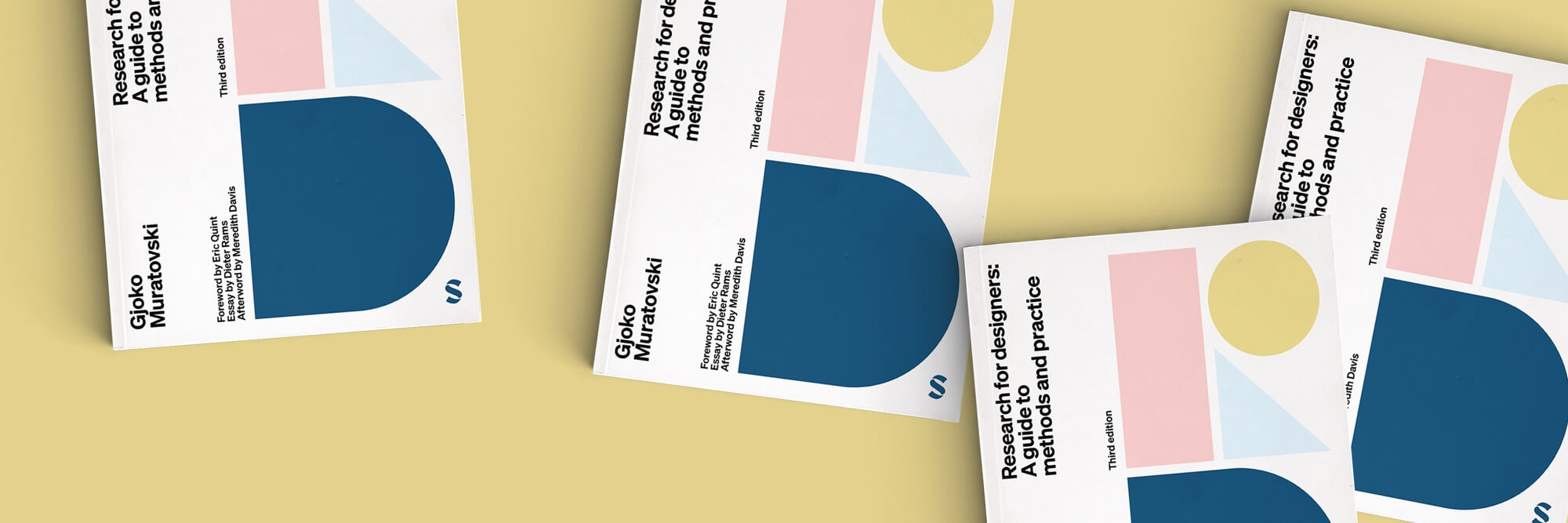
  • The defining feature of "Research for Designers" is its structure. Complex research methods are broken down into a clear, step-by-step guide that makes an exceptionally wide range of methods accessible and immediately applicable, regardless of the reader's research background.The book is also a design artefact in its own right. Since its second edition, it has featured an original cover by Michael Bierut of Pentagram, the designer behind the visual identities of MasterCard, Saks Fifth Avenue, and The New York Times.Its contributors are equally distinctive, featuring design luminaries including Don Norman, Karim Rashid, Ken Friedman, Dieter Rams, and Richard Danne, the design director behind the NASA visual identity, alongside designers from IBM, Google, Amazon, Microsoft, Philips, Johnson & Johnson, Procter & Gamble, Cisco, Meta, the White House, and the US Air Force. Topics range from designing life-saving medical devices and space mission products to decolonising design, social innovation, and government policy.As of 2025, the book extends beyond the printed page with the AI+ Accelerator: Research for Designers, a dedicated digital learning platform that teaches designers how to integrate AI tools responsibly and effectively into their research practice, ensuring the resource remains relevant and future-ready for the next generation of designers.