Gloria Jean’s Reset: A Design-Led Repositioning Strategy for a 150-Store Australian Franchise QSR Café Network

good-design-award_winner_rgb_blk_logo
  • 2026

  • Design Strategy

Commissioned By:

Retail Food Group (RFG)

Designed In:

Australia

COOOP applied it’s evidence-based practitioner-led methodology to reposition Gloria Jean’s, a 150-store Australian franchise quick service café network, as a commercially relevant, multi-generational brand. This served as a strategic instrument throughout the process, from diagnostic analysis to validated national rollout.
view website
Buy online

2.jpg
Kera Wong Photography
3.jpg
Kera Wong Photography
  • CHALLENGE
  • SOLUTION
  • IMPACT
  • MORE
  • Gloria Jean’s set out to renew the relevance of its brand across a multi-generational customer base while preserving the loyalty of its established patron community nationally. The brief required a design strategy that could simultaneously serve the established espresso-loyal patron cohort, a younger adult and adolescent audience drawn to chillers and specialty lattes, and the commercial upsell opportunity of converting single-drink transactions into drink-plus-food pairings. It also required a rollout model accessible to franchise operators across a range of capital capacity, from full new-build sites to existing fitouts approaching lease renewal.

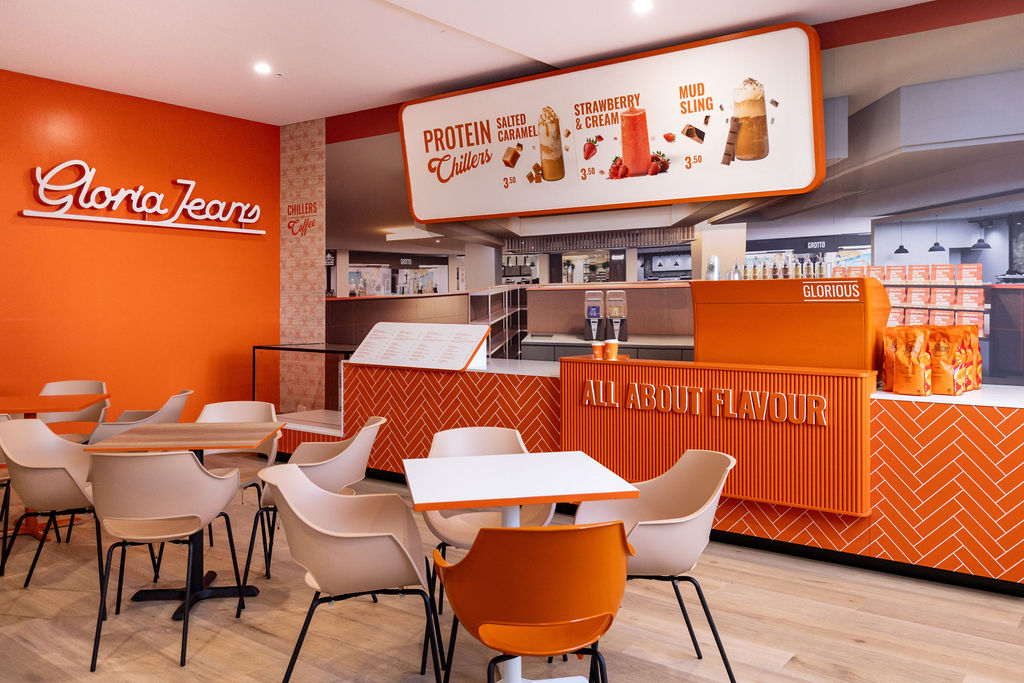
  • COOOP audited 100 network stores, 65 physically and 35 virtually, mapping spatial conditions suppressing brand legibility and patron engagement. The Envirohacking® Lab was commissioned as a dedicated prototype environment: a non-operational spatial build simulating shopping centre threshold conditions, validating the new concept before any commercial fitout commenced. Two sequential workshops engaged RFG brand and commercial teams, then franchise partners from across the network. Their direct experience of the prototype refined chair selection, signage, brand details and fitout specifications. Two validated rollout pathways were produced: a new-build concept and a partial revamp retaining upto 75% per cent of existing fitout investment.

  • The Goulburn flagship store recorded 35% revenue uplift in the first 4 weeks, sustaining a healthy double-digit plateau over 8 months. Rollout continues subject to individual lease renewal terms. The 100-store diagnostic audit confirmed a partial revamp pathway that made the concept accessible to franchisees with limited capital, extending design-led recovery to the network's most commercially vulnerable operators, and is significant from sustainability point of view. Prototype methodology compressed concept adoption time by 75% compared to conventional franchise design process. The workshop spinoff to franchise partner roadshow measurably increased interest in the refurbishment programme across the network.

  • Engagement with franchise partners inside the prototype produced documented refinements: chair selection, signage, brand presentation and fitout specifications. The concept absorbed operator knowledge without structural revision.COOOP developed the proprietary Glorange colour system to restore Gloria Jean’s instant brand recognition at the critical approach distance where purchase decisions occur. The mono-colour orange became brand-owned spatial IP embedded directly into the environment.Behavioural diagnostics identified overhead menu boards as major suppressor, particularly for older patrons who struggled with visibility and readability. These were replaced with LED product displays designed to attract customers from a distance, while new physical menu boards were repositioned at counter height to align with natural downward reading behaviours.The concept was calibrated for two distinct customer groups: loyal patrons aged 60–75 seeking familiarity and physical menus and younger consumers requiring contemporary repositioning. Both cohorts were validated in the Envirohacking Lab through workshops with franchisees representing the network’s multicultural and socioeconomic diversity.New self-service stations were introduced alongside physical menus, reflecting COOOP’s ethical “Consent Architecture” approach for cognitively diverse audiences. Final refinements included seating with rounded arms to assist older users, revised table formats to increase seating efficiency and improved font size and materiality for accessibility and usability.