Designing the Intellectual Edge: A Strategy for Future Defence Learning

good-design-award_best-in-class_rgb_blk_logo
  • 2026

  • Design Strategy

Commissioned By:

Australian Defence College

Designed In:

Australia

This project presents a design-led strategy for future Defence learning, developed for the Australian Defence College. It integrates pedagogies, technology, and learning environments to build cognitive capability in complex, unpredictable contexts, enabling Defence personnel to think, adapt, and respond effectively in rapidly evolving operational environments.

2.jpg
3.jpg
4.jpg
5.jpg
6.jpg
7.jpg
8.jpg
  • CHALLENGE
  • SOLUTION
  • IMPACT
  • MORE
  • Traditional Defence education models are increasingly misaligned with the demands of complex, rapidly evolving operational environments. Existing approaches rely on static content delivery, hierarchical classrooms, and fragmented systems that do not support adaptive thinking or decision-making under pressure. A key challenge was the lack of integration between pedagogy, learning environments, and emerging technologies, limiting the development of cognitive capability across the workforce. The project also needed to respond to diverse stakeholders, future workforce growth, and infrastructure constraints, requiring a scalable and adaptable approach to learning that reflects real-world Defence contexts.

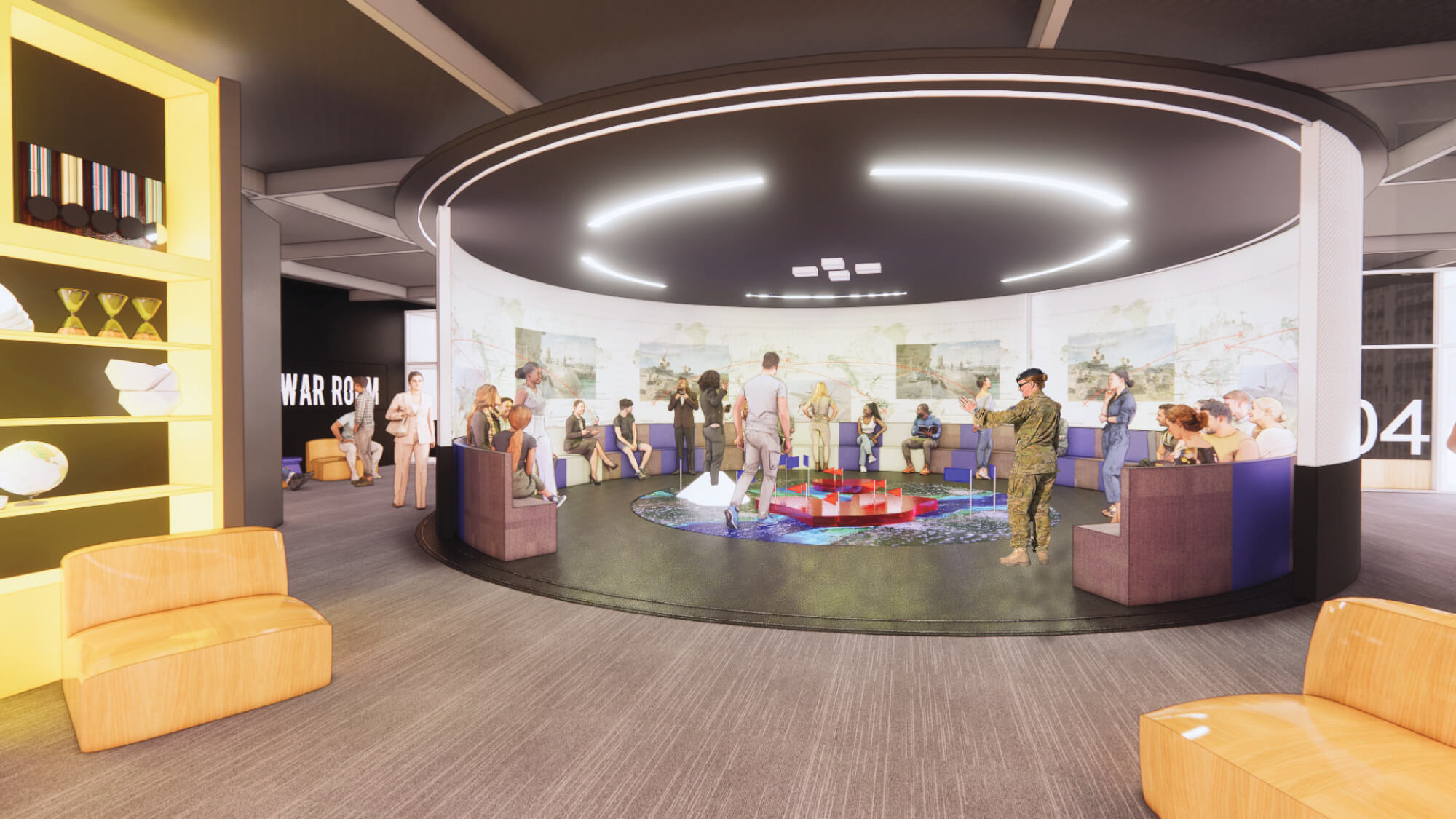
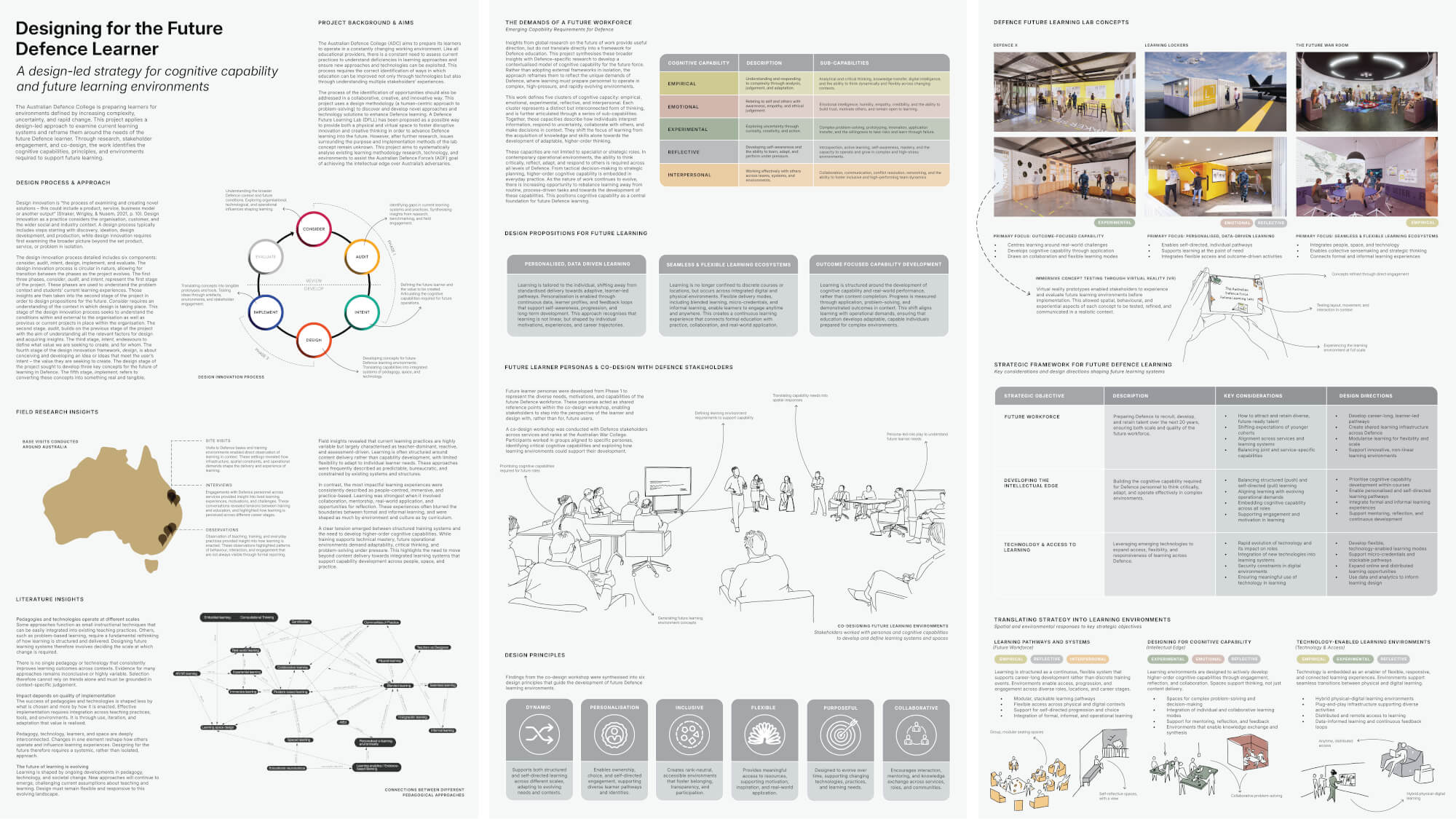
  • The project introduces a design-led strategy that reconfigures Defence learning as an integrated system of pedagogy, space, technology, and user experience. Through research and co-design with Defence stakeholders, a cognitive capability framework and six design principles were developed to guide future learning environments. These are translated into three prototype concepts: Defence× (for complex problem-solving), Learning Lockers (mobile operational labs), and The Future War Room (a collaborative, rank-agnostic environment for strategic). Rather than a single solution, the project establishes a scalable model for continuous evolution of Defence learning system.

  • This strategy established a new model for Defence learning by connecting cognitive capability development with pedagogy, infrastructure, and workforce planning. It provides a scalable framework to guide future investment and reduce risk in infrastructure decisions by ensuring alignment with operational needs. By shifting focus from training delivery to capability development, it supports more adaptive, collaborative, and effective decision-making across Defence. The approach also has broader relevance, offering a transferable model for designing learning systems in other complex, high-risk industries.

  • Delivered over a 12-month period, the project adopted an iterative, design-led approach integrating research, strategy, and concept development to explore future Defence learning. A key feature was the integration of foresight research into pedagogy, Defence trends, and future operational contexts, ensuring the strategy responds to emerging challenges rather than current-state assumptions. The project brought together an interdisciplinary team of experts across design, Defence, education, and strategy, enabling diverse perspectives and strengthening applicability across contexts. Central to the process was the use of co-design and boundary objects (e.g. capability cards and personas) to align stakeholders and translate complex ideas into actionable outcomes. The resulting concepts demonstrate how integrated learning environments can support cognitive capability development, positioning design as a strategic tool for shaping future Defence learning systems