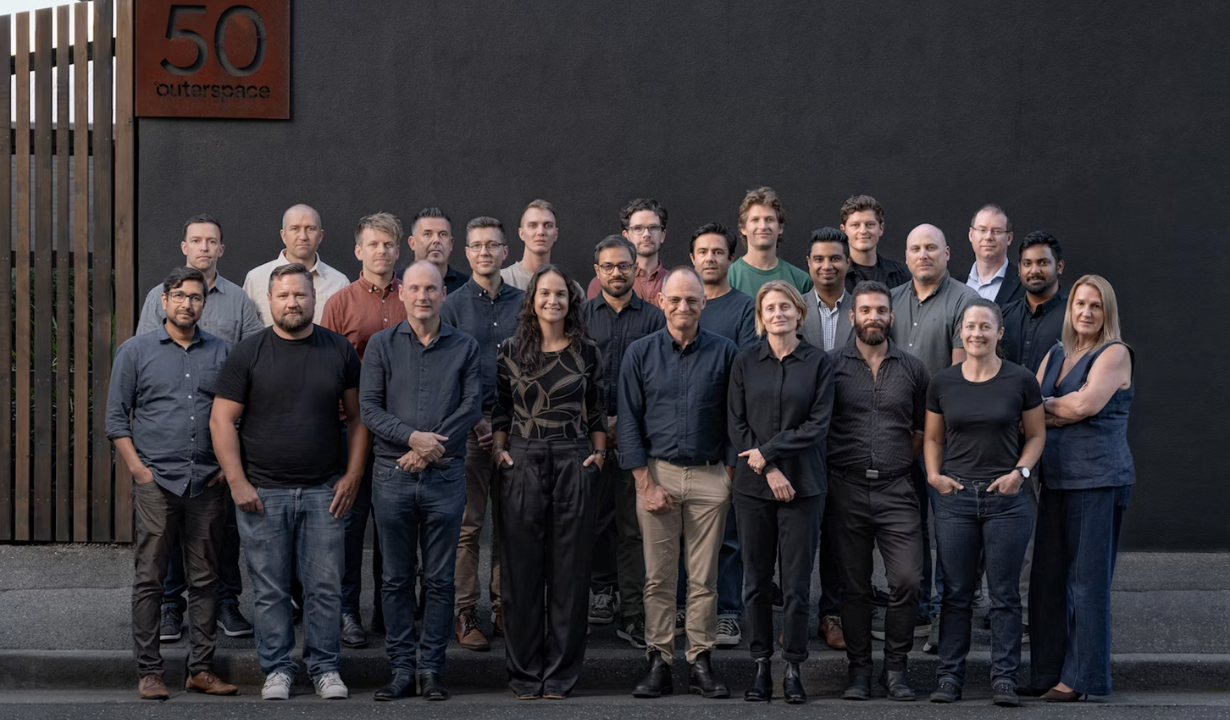
Outerspace – 2026 Good Design Team of the Year
- Published on: 14 October 2026
Share
THIS ACCOLADE CELEBRATES A DESIGN TEAM WHO CONSISTENTLY PERFORMS AT THE HIGHEST LEVEL IN THE ANNUAL AUSTRALIAN GOOD DESIGN AWARDS AND HAS ESTABLISHED A TANGIBLE DESIGN-LED CULTURE WITHIN THEIR ORGANISATION.
THE AWARD AIMS TO INSPIRE COMPANIES TO BUILD AND MAINTAIN A DESIGN-LED CULTURE THROUGHOUT THE WORKPLACE.
“It failed, failed, failed until it started to succeed.”
That’s Fred Blochlinger, Founder and Managing Director of Outerspace, describing one of the studio’s projects. It’s an unusual thing for a team with more than 100 industry awards to be proud of, but it says a lot about how they work.
At the studio, every idea is tested, challenged and refined until it earns its place. Briefs get questioned, the loudest voice doesn’t win, and designers and engineers push back on each other long before anything reaches a client.
That culture has produced everything from Zygo, a world-first underwater communication system, to Presto, a machine that cleans salon hairbrushes. In 2021, Zygo took Gold and Presto won Best in Class at the Australian Good Design Awards, alongside Gold for a digital asthma monitor for families. In 2025, a wound drainage pump and a lockable dog leash joined the list. This year, Outerspace has been named the 2026 Good Design Team of the Year.
We sat down with Fred and Christian Tucker, Head of Design, to talk about productive friction, being prepared to fail, and the shared language that lets design-led thinking run through every discipline.

Outerspace, Winner of the 2026 Good Design Team of the Year Award | vf3 mini e-suv
Different languages, one process
Outerspace is led by industrial designers, and that shapes how every project is structured, resourced and measured.
“Design is part of every discipline,” said Christian. “We try not to have design and design thinking siloed at the strategic or user front end.”
Holding that line got harder as the studio grew from a design company into a full-service design and engineering firm. It built out those disciplines for a reason. As a design and mechanical team, it was becoming one part of a project rather than guiding it.
“When you have different partners with different disciplines all working for a client, every one of those disciplines tends to treat the problem as a hammer and nail,” said Fred. With the whole team together, it’s easier to balance what matters for the business and the end user.
Bringing everyone under one roof created a new challenge. Around five years ago, as engineering capability grew, a few projects lost their balance. “We potentially swung from design to engineering a little too far,” said Christian.
The answer was a common design process that every discipline could follow. Along the way, the team found the gap between design and engineering was smaller than it looked.
“All of the individual disciplines, the electronic engineers, the firmware engineers, the systems engineers, really do their own version of a design process,” said Christian. “It’s just that they speak a different language.”
Translating between them took real work, with some push and pull and plenty of training along the way. The result is a process where design principles sit inside the engineering, not on top of it.
“Design is not overshadowing the other disciplines. It’s a design-led product development process,” added Fred.
Challenge and be challenged
Outerspace’s culture comes down to four words: Clarity, Capability, Creativity and Collaboration. They aren’t a skills list. Together, they help each person’s talent combine with everyone else’s and multiply through the process.
Christian is the first to admit the last one gets thrown around. “Collaboration’s a key word, but it can easily be clichéd, can’t it?”
So the studio makes it specific. At Outerspace, collaboration means a willingness to challenge and be challenged, with clients and with each other.
Putting designers, engineers, testers, coders and makers under one roof sounds like a recipe for efficiency. The real value is friction. Ideas are pressure-tested. Senior practitioners are part of that debate too, still working on the tools rather than managing from a distance.
Bringing everyone in early pays off. “Having those small teams together early means we can look at some of the challenges and the risks from a technical point of view, bring them forward, and then balance them out with the experience,” said Fred.
It shows up in client work too. “We’re effectively engaged to provide that design leadership and take a bit of a risk, as if it was our own project, our own money, our own stakeholders,” he said. “Our clients like working long term, mainly because we will take a risk.”
The questioning goes beyond design. “Often a client sees the world in a narrow sense of either developing a product or a prototype,” Fred added. “They may not necessarily have a full understanding of the difference between the value of an idea, the value of a product, and the value of a business.”
Outerspace helps them see the bigger picture and ask the right questions early, before they invest too soon.
That willingness to challenge and be challenged is a big part of how a team of around 30 stays nimble enough to compete with much larger studios.
The loudest voice doesn’t win
Productive friction depends on who gets heard. At Outerspace, everyone has a say, regardless of seniority or discipline. If you can see something, you are always safe to say something.
“It’s not so much a specific thing that happens in a meeting,” explained Christian. “It’s more about the general culture of the company, and everyone feeling comfortable to say what they think, and everyone being encouraged to listen.”

Outerspace, Winner of the 2026 Good Design Team of the Year Award | Gaming VR glasses
Open to different ways of thinking
Outerspace’s work depends on people who are world-leading in their field. The studio’s job is to create an environment where that expertise can thrive.
When the Holden design studio closed, Outerspace brought on some of its key talent, keeping world-class automotive skills in Australia.
“Automotive designers and engineers often spend their entire careers working between one or two companies,” said Christian. “It is its own world, and they are really, really good at certain things.”
Car companies tend to run on tightly defined roles and a set order for doing things. Outerspace gave the Holden team more freedom, bringing them into its faster, more iterative process and putting their skills to work across other projects. Automotive-grade capabilities now shows up in every sector the studio serves.
The same goes for different ways of thinking. Outerspace sees neurodiversity as a design asset and builds around people’s strengths.
“If you really want someone who is the absolute best at something, you need to be open to different ways of thinking about things,” said Christian. “Rather than making that an obstacle , why don’t we embrace that and lean into their strengths? It’s really about reducing the barriers to specialist success.”
The breadth of the work helps too. Outerspace works across so many industries that it can bring an idea into a sector where no one has tried it before.
Ultra-lightweight sports is one example. Working in that space, the team learned to start with the absolute minimum a design needs to do its job.
On one project, they applied that thinking to a new product. It was the opposite of the typical engineering approach, where a product is designed with everything it could need, then cut back until it starts to fail. Outerspace started with the bare minimum and built up from there. Early versions failed, and the team kept building until it worked.
“It’s turning an approach on its head,” explained Fred, “and being happy to fail until you can start succeeding.”
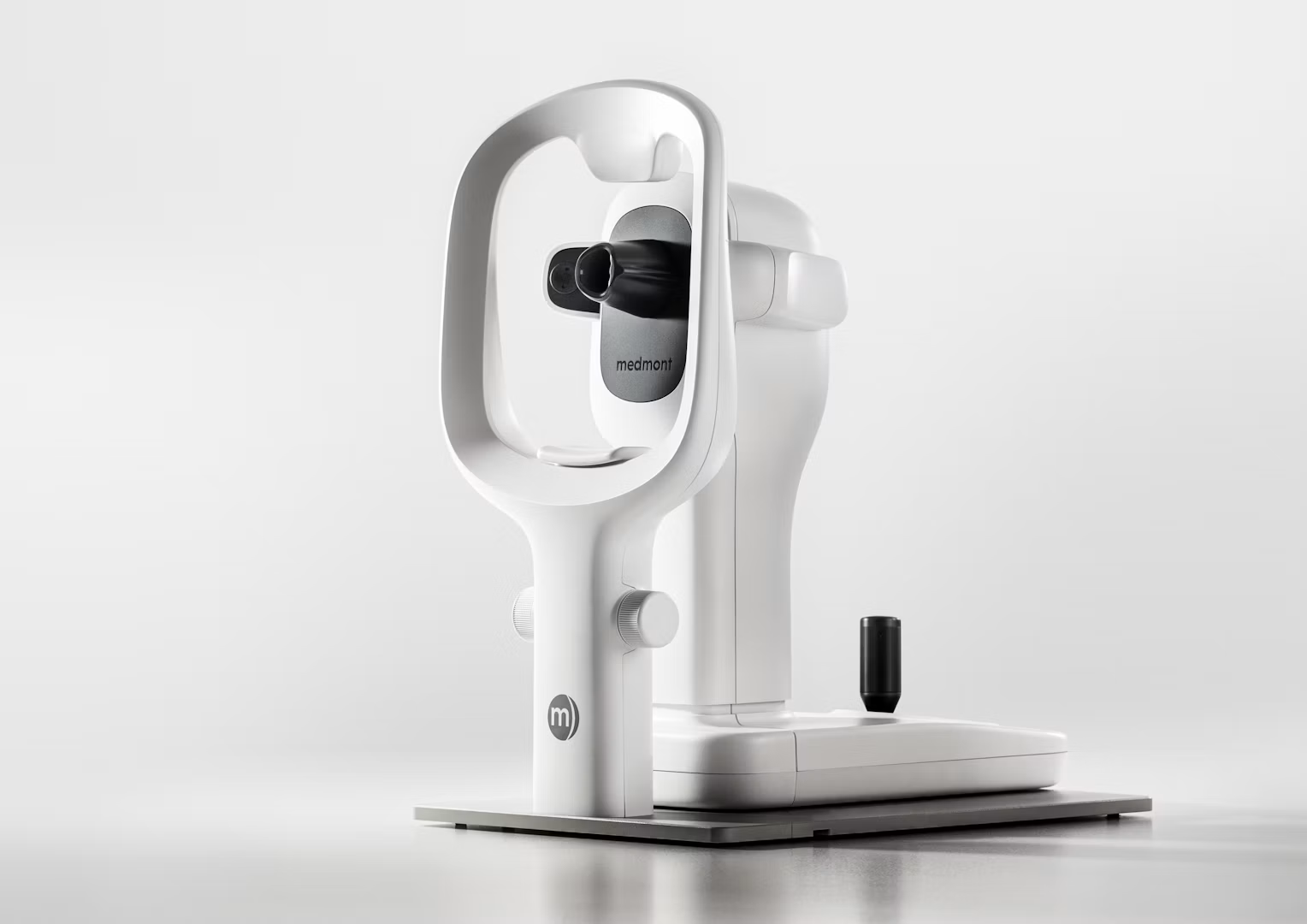
Outerspace, Winner of the 2026 Good Design Team of the Year Award | Medmont
Embedding a design-led culture
For leaders looking to build a design-led culture of their own, Outerspace says it starts with understanding the role design can play.
That role goes well beyond how something looks. It’s how a team approaches a problem and works it through. The challenge is making that thinking part of how the whole business operates.
That comes down to process. There are hundreds to choose from, and Christian’s advice is to learn them and find what’s right for your business.
“Creating a process that benefits everyone, and that everyone is happy to engage with, will inevitably create a design culture,” he said.
Recognition that belongs to everyone
For Outerspace, this award stands apart. It recognises the team and the culture behind the work, rather than any single project or individual.
“Although we’ve won many product awards over the years, this feels different because it recognises something we’ve been consciously building for a long time,” said Christian. “A way of working where different disciplines challenge each other, concepts are tested, and better ideas emerge.”
“It validates the journey we’ve been on, but more importantly it belongs to everyone in the team and recognises the everyday contributions that often go unseen.”
As the studio has grown into a multidisciplinary product development team, it has worked hard to make sure design thinking hasn’t been diluted. “Designers, engineers, software developers and makers all see problems differently, and the tension between those perspectives often leads to better outcomes,” he said.
Christian also credits the studio’s clients. “Many have trusted us with difficult, ambitious problems, given us the freedom to challenge assumptions, and allowed us to become genuine partners rather than just service providers.”
What’s next
Outerspace is preparing to announce a collaboration with one of Australia’s highest profile global events brands. The Melbourne studio and its San Diego office are also attracting a growing number of overseas clients who want original solutions built through an integrated design and engineering process.
Good Design Australia congratulates Outerspace on a culture where designers and engineers share one language, every idea is challenged before it’s accepted, and the whole team is greater than its parts.
More News