Robert Pataki Award for Healthcare Design
- Published on: 3 November 2025
Share
SCOOT: Open Source Power Assist – 2025 Robert Pataki Award for Healthcare Design
NAMED IN HONOUR OF ROBERT PATAKI OAM, RECIPIENT OF THE 2022 AUSTRALIAN DESIGN PRIZE, LIFE FELLOW OF THE DESIGN INSTITUTE OF AUSTRALIA AND INDUSTRIAL DESIGN PIONEER, THE ROBERT PATAKI AWARD FOR HEALTHCARE DESIGN AIMS TO INSPIRE, RECOGNISE AND SUPPORT DESIGN SOLUTIONS THAT HAVE THE POTENTIAL TO IMPROVE THE LIVES OF PEOPLE LIVING OR WORKING WITHIN THE HEALTHCARE SYSTEM.
Driven by curiosity, empathy, and hands-on problem-solving, designer Edward (Teddy) Meredith created SCOOT – an open-source power-assist system for manual wheelchairs, built to make movement safer, simpler, and more reliable.
He’s a designer who thrives on rolling up his sleeves, testing ideas in the workshop, and figuring out what actually works for people.
At its core, SCOOT is user-centred. From its off-the-shelf motors to its affordable, safe, and repairable design, every decision is shaped by the needs of wheelchair users.
We spoke with Teddy Meredith, a recent QUT Industrial Design graduate, to learn hours of iteration and trial and error turned a simple idea and a toolbox into a device that could redefine mobility and independence for wheelchair users worldwide.
SCOOT demonstrates that design works best when made with, and for, the people who rely on it. Keep reading to explore how Teddy’s hands-on approach makes it possible. Now, this recognition is propelling him toward a successful launch.

Edward (Teddy) Meredith. Image: Supplied
Addressing challenges with practical creativity
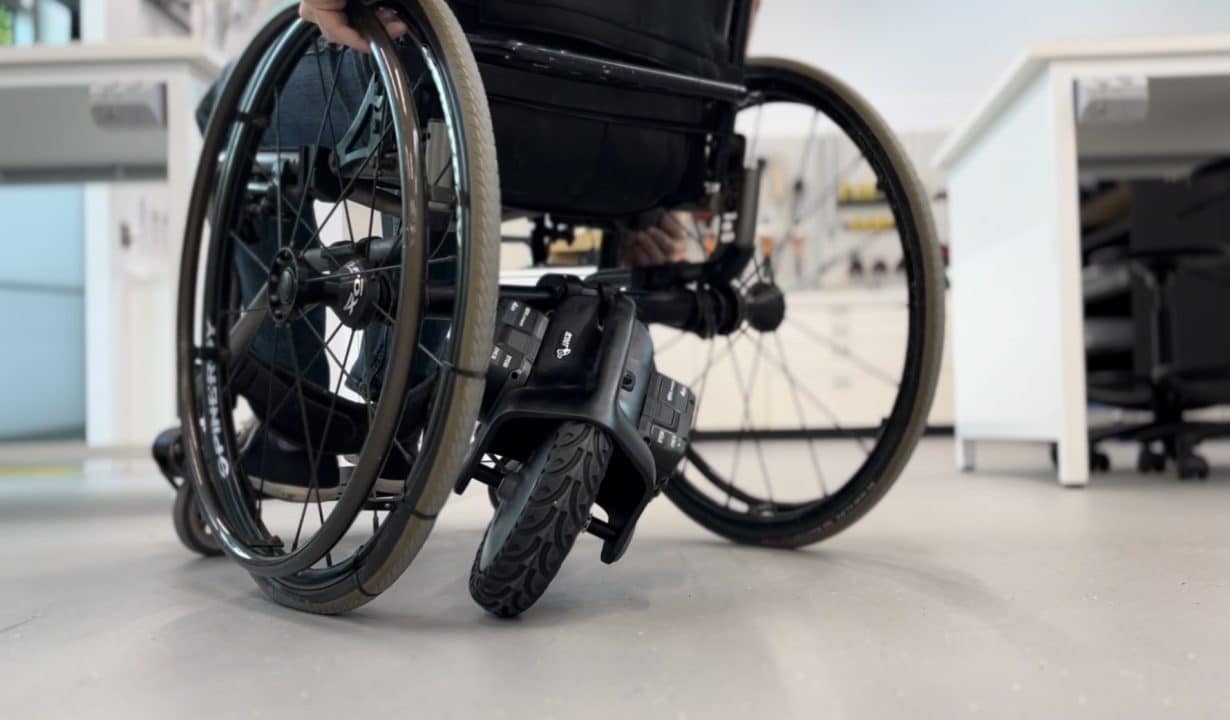
SCOOT is designed to attach to a manual wheelchair and help propel the user forward. Compact, affordable, and easy to maintain, it’s built from off-the-shelf electric scooter parts and powered by standard Ryobi drill batteries. This approach brings mobility support within reach for more people.
Around one per cent of the world’s population uses a wheelchair, with more than 200,000 in Australia alone. Existing power-assist systems are often expensive, difficult to maintain, and rely on overseas suppliers, with delays through NDIS or prescription approvals adding further barriers.
“[Power-assist systems] are great, but they’re really expensive, and you have to get them prescribed,” Teddy explained.
“If it breaks, you’re usually left with no recourse. The manufacturers aren’t often based in Australia. They’re in Europe or America.”
SCOOT is set to solve these problems with readily available components.
“If the motor goes bad, you can just hop down to a scooter shop and replace it. The parts are everywhere,” he said.
By designing for accessibility, repairability, and safety, and integrating features like safe-stop, SCOOT directly addresses everyday frustrations, proving how thoughtful design can have a genuine impact on independence.

SCOOT demo stand. Image: Supplied
From passion to prototype
Circularity has always been at the heart of Teddy’s approach. As a kid, he loved restoring bikes and cars. Later, working as a tradesman in air conditioning, he learned the value of fixing, maintaining, and extending the life of products. Even repairing his own t-shirts with holes followed the same principle: make things last rather than throw them away.
“I hate the idea of one part breaking and the whole unit being thrown out,” he explained.
“I wanted the design to last, to keep it in use, and to fit a circular economy mindset. That’s partly why I chose off-the-shelf motors and RYOBI batteries. Users can source parts themselves, they don’t need to go through me or SCOOT. They could go to a scooter or bike shop, people have seen these components before. The goal was to keep it serviceable, not disposable.”
Ultimately, Teddy’s passion for people, sustainability, and long-lasting design is what defines SCOOT. It’s built to endure, evolve, and empower.

SCOOT direct behind. Image: Supplied
Open-source design for global accessibility
Teddy designed SCOOT to be open-source and user-focused, guided by a simple question: how would I want to receive a product myself?
“I’d want to be able to fix it,” he explained. “I’m really into cars and technology, and the right-to-repair movement is a big deal for me. So if I’m designing something like this, those values have to be integrated from the start.”
The design process was shaped by hands-on feedback from wheelchair users.
“It’s about understanding how the user is going to use this today, but also how they’ll use it over time,” he said. “I want someone to have a ten-year-old unit, and if the motor goes bad, they can just replace it and keep going.”
Teddy also sees the broader social impact.
“The real difference comes when a country doesn’t have a social safety net… It can be the difference between going into town and socialising independently, versus needing help for day-to-day life.”
While wheelchair users in Australia already benefit from NDIS support, many still face delays and high costs. SCOOT aims to keep mobility affordable and immediately accessible.
“If I can keep the cost low, users don’t need prescriptions or approvals. It fits within NDIS allowances, and for those outside the system, some users would rather pay to secure a reliable unit themselves than wait for approval.”
By keeping SCOOT open-source and built from readily available components, Teddy has created a repairable, maintainable, and scalable solution, providing wheelchair users everywhere with practical, affordable mobility they can trust.

SCOOT control. Image: Supplied
Hands-on experimentation
With a mix of creativity, technical skill, and relentless hands-on experimentation, Teddy’s approach turns problem-solving into a playful challenge, with a touch of fun along the way.
“I actually loved the process,” he said. “I’m a former tradesman and I’m really good with tools, so I had access to the workshop at QUT. I just went for it,” Teddy explained.
To test the system, he even built a wooden go-kart powered by the same motors and batteries, reaching close to 30 km/h.
“It was terrifying and brilliant at the same time,” he laughed.
“Everything was driven by making sure the product would work. I’d do hill testing, directional changes, and work on controlling the wheel with a chip.”
I hotwired the motor controller with an Arduino and coded it to limit the top speed. It was like riding around campus with a laptop on my lap, monitoring acceleration and speed while not crashing myself,” Teddy continued.
This hands-on experimentation guided every design decision. Components were chosen for accessibility and durability, ensuring users could maintain and repair their units independently.
“Dozens of hours, lots of testing, learning by doing, trial and error. Just figuring it out along the way,” Teddy explained, reflecting on his semester-long design process at QUT.
“Fail fast, fail often, that’s something one of my professors, Dan Cook, always said. Sometimes the quickest way to find out what works is by discovering all the ways that don’t. You can get stuck in indecision, wondering which idea is best, but the key is to just make it, test it, and tweak it. That’s the iterative design process: build, observe, refine, and repeat until it works,” he added.

SCOOT. Image: Supplied
Mentorship and the road to market
At this stage, SCOOT exists as a working prototype, ready for user testing, but not yet market-ready. Teddy has mastered prototyping and hands-on design, but bringing a product to market requires a different skill set.
“I’ve never started a company or had to bring a product to market,” he admits.
“I can make something work, but I don’t know how to set up manufacturing, get a custom circuit board made, or make it economical.”
“I could figure it out myself through more trial and error,” Teddy said, “but the best trial and error is learning from someone else. It saves all the time and heartache.”
Receiving the Robert Pataki Award for Healthcare Design will help Teddy take SCOOT to the next stage, guide him through refining SCOOT for market readiness and navigating the steps for a successful launch. With mentorship, financial support, and guidance, the project is poised to move from prototype to a healthcare solution that could benefit users worldwide.
“It makes it feel like I can actually bring it to market. It feels tangible now,” he said, excited about SCOOT’s next steps after receiving recognition on the global design stage.

SCOOT attachment. Image: Supplied
Behind the designer
A hands-on designer, Teddy thrives on turning ideas into tangible, functional products.
“Prototyping leads to the best results. No CAD model compares to holding it in your hand,” he said.
“When it comes to products like SCOOT, user-centric design is everything,” he explained.
“It’s our job to improve people’s lives. If a product can also be repairable and built to last, even better.”
Lessons from his trades work taught him the value of a circular economy. He is passionate about reusing, repairing, and extending the life of products.
For Teddy, good design isn’t just about making something work; it’s about making something last, something people can keep using, learning from, and adapting over time.
From sourcing batteries on eBay to building a go-kart, Teddy Meredith has taken SCOOT from playful experimentation to a fully prototyped mobility solution with real-world potential.
With hands-on, user-centred thinking and support from the Robert Pataki Award, SCOOT is ready to reach the people who need it most. It addresses a major gap: the lack of direct-to-consumer products in healthcare technology.
Good Design Australia congratulates Teddy for showing how innovative, intuitive design has the power to genuinely improve lives, and for using his passion for healthcare design to test, explore, and reveal what’s possible with practical creativity, collaboration, and a whole lot of heart.