Things Gather Things

good-design-award_winner_rgb_blk_logo

Things Gathering Things is a temporary civic pavilion developed for Muswellbrook, NSW, responding to the Hunter Valley’s energy transition. Combining cooling mist, native plants, storytelling and live digital projection, the reusable structure created an inclusive and alluring public space for conversation, reflection and exchange.


2.jpg
Project Team
3.JPG
Heidi Axelsen
4.JPG
Heidi Axelsen
5.JPG
Heidi Axelsen
6.JPG
D'Arcy Newberry-Dupé
7.JPG
Project Team
8.JPG
Project Team
  • CHALLENGE
  • SOLUTION
  • IMPACT
  • MORE
  • Things Gathering Things responded to the challenge of creating meaningful public space within a regional town undergoing significant social, economic and environmental transition following the planned closure of major coal infrastructure in the region. Conventional public consultation around energy transition is often politically charged, extractive and institutionally framed, producing fatigue and distrust within local communities. We sought to develop an alternative civic model: a temporary, inclusive and non-didactic space that encouraged informal gathering, conversation and reflection. The designers needed to work within very limited budgets, extreme summer heat conditions, a short installation timeframe and a demand for reuse and sustainability.

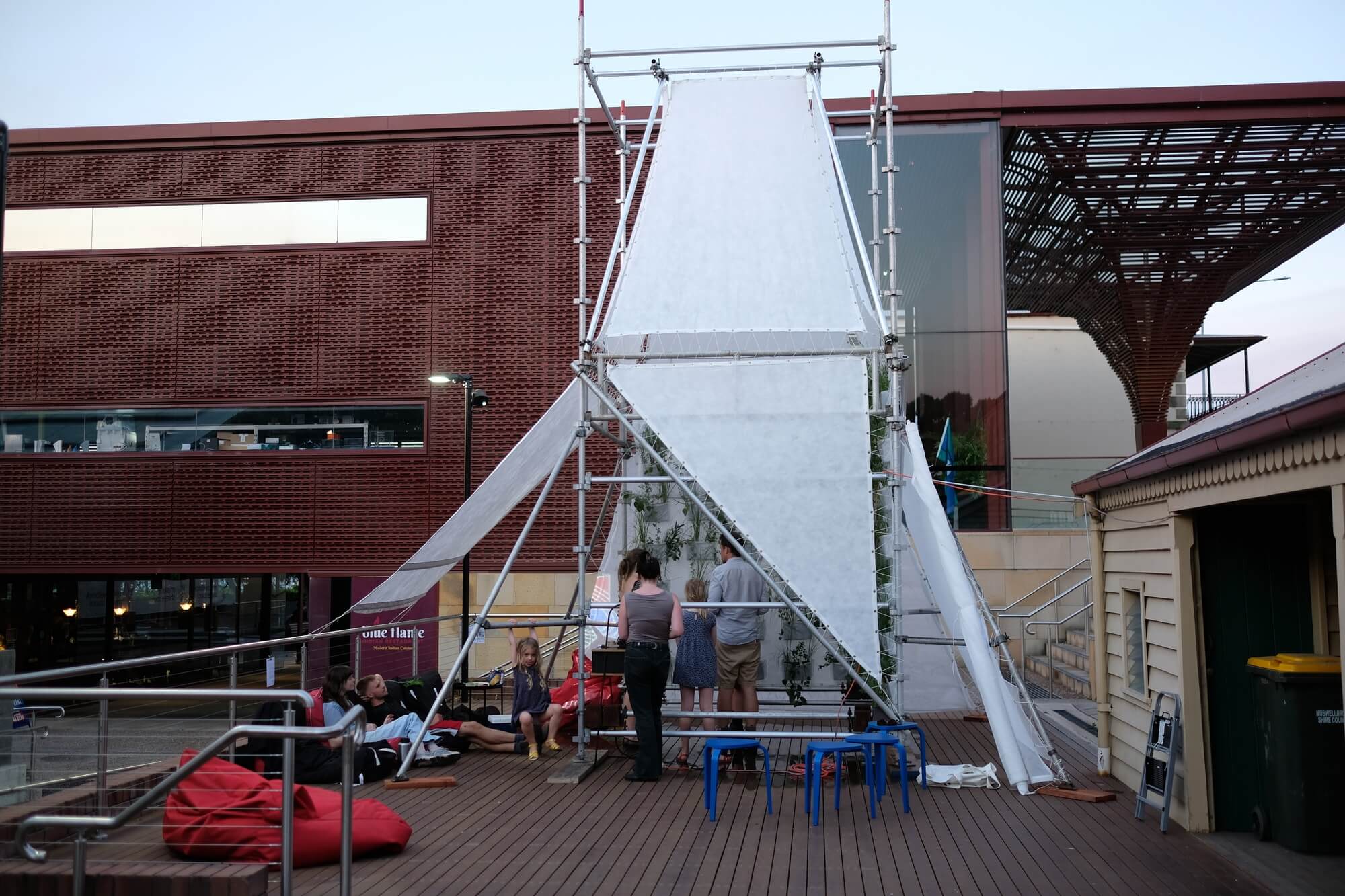
  • The project responded with the design of a compact, humble and reusable pavilion combining scaffold infrastructure, translucent fabric, native planting, cooling mist, live digital scanning and projections. Formally referencing the cooling towers of the Hunter Valley power stations, the pavilion transformed a hard urban site into a shaded microclimate and informal gathering space. Developed through collaboration between Muswellbrook Shire Council, University of Newcastle and local community stakeholders, we encouraged embodied engagement with the social and environmental realities of energy transition. Installed during extreme heat conditions, the pavilion balanced rapid deployment, accessibility and low environmental impact within a scalable civic model.

  • This project demonstrated how inexpensive, temporary architecture can support meaningful civic engagement within communities experiencing environmental and economic transition. Socially, the project created inclusive and accessible public space that encouraged intergenerational participation, informal conversation and collective reflection. Environmentally, the pavilion operated as lightweight climate infrastructure, providing cooling relief during extreme heat while using rented scaffold systems, reusable materials and zero landfill waste. Commercially, the project tested a low-cost and rapidly deployable civic model capable of adaptation across regional towns with limited resources. The pavilion also established a growing digital archive of local objects, memories and community histories connected to place.

  • Things Gathering Things combines temporary architecture, climate responsiveness and participatory storytelling within lightweight and reusable civic structure. The pavilion measured 2.4m x 2.4m and stood 5m high, constructed using rented scaffold infrastructure, custom translucent fabric and integrated misting systems designed for rapid assembly and disassembly by small teams.Referencing the cooling towers of the regions coal industry, the pavilion transformed an industrial typology into an open and welcoming public space. By day, the structure operated as a shaded microclimate where cooling mist, native planting and filtered light provided thermal relief during heatwave conditions. By night, it became an illuminated projection surface displaying live digital scans of community-contributed objects.The project also operated as a live educational platform, connecting first year architecture students from the University of Newcastle directly with regional communities, local histories and the environmental realities of post-extractive landscapes. Students participated in the initial design process, focusing their studies on these unique conditions.Visitors contributed meaningful personal artefacts to be scanned in exchange for locally sourced native plants including Willow-leavedHakea, Cut-Leaved BushMint, Tussock Grass and Saltbush.The project prioritised free participation, wheelchair access and all-ages programming while testing a scalable model for temporary civic infrastructure across regional transition towns.