A Guide to Symbiocene Design
- Published on: 4 June 2026
Share
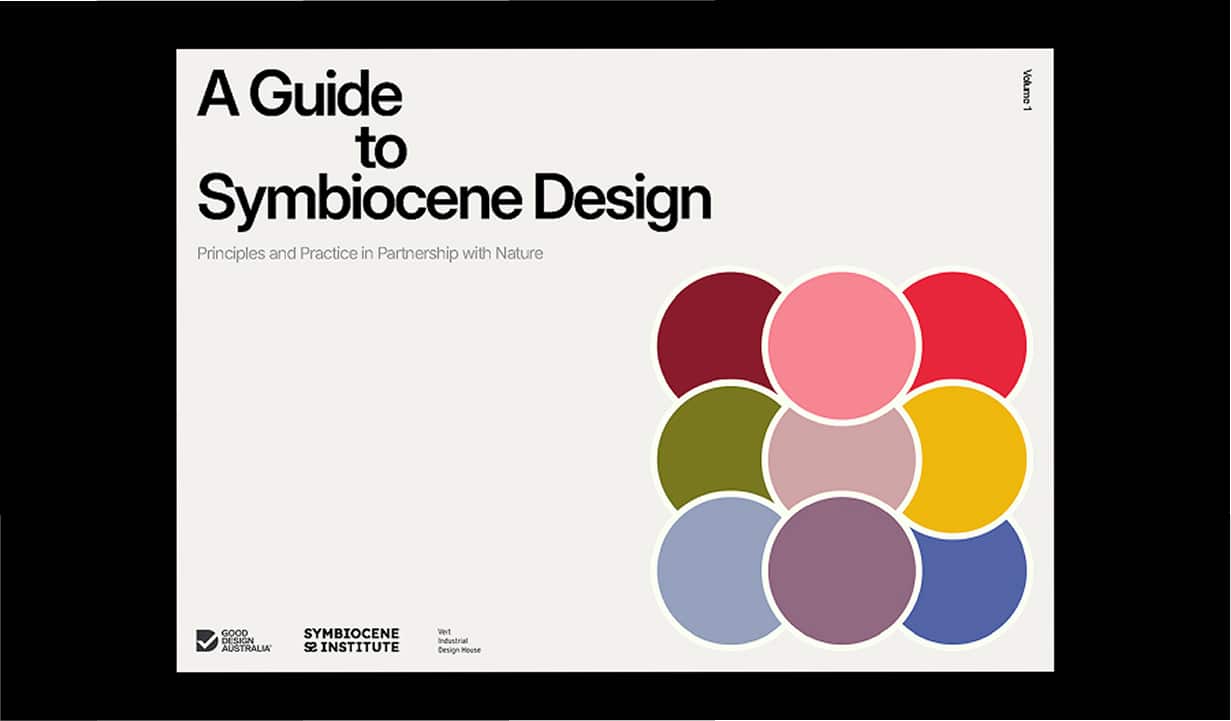
A Guide to Symbiocene Design is available to download now from the Symbiocene Institute.
Far beyond simply reducing harm, design has the potential to do good and create immeasurable positive impact. Good Design Australia has been working with the Symbiocene Institute and Vert Industrial Design to develop the recently launched design guide titled – A Guide to Symbiocene Design.
The guide draws on the work of Glenn Albrecht, who first set out the Symbiocene in his book, Earth Emotions, and offers a practical approach to help designers and decision-makers reconcile human needs and desires with the wellbeing of all life.
The Symbiocene proposes a shift away from the Anthropocene – an era defined by humanity’s domination of nature – towards a future grounded in symbiosis, where humans are guardians of the natural world.
This emerging movement shaped A Guide to Symbiocene Design, which outlines nine guiding principles for Symbiocene-compatible design. These principles are supported by 50 real-world examples from around the globe, as well as new design concepts that imagine non-human clients like bees, frogs and kookaburras. Together, they show what partnering with nature looks like in practice.
We spoke with Andy Marks, Founder and Executive Director of the Symbiocene Institute, about the guide, the approach behind it and how designers can be pathfinders to a better future.
GDA: The Symbiocene began in environmental philosophy with Glenn Albrecht’s book, Earth Emotions. Why is design the right discipline to carry it forward today?
Andy Marks: We are at a really challenging and interesting time. People call it the Anthropocene, a destructive time caused by humans.
Humankind’s appetite, desires and needs are out of line with the ability of the planet to sustain life. We’re facing multiple crises.
We need to shift our field of vision, raise our ambition and use innovation to help guide us out of the mess we’re in.
For us, design is quite a broad church around processes that are solving complex problems. Designers are key to that, as disciplines that create new things, put new things into the world, create new processes, and shape the world around us.
So what we would like to do with this guide is look at some really great, bold, ambitious, and practically achievable destinations we can get to and have designers be the guides to that better future.
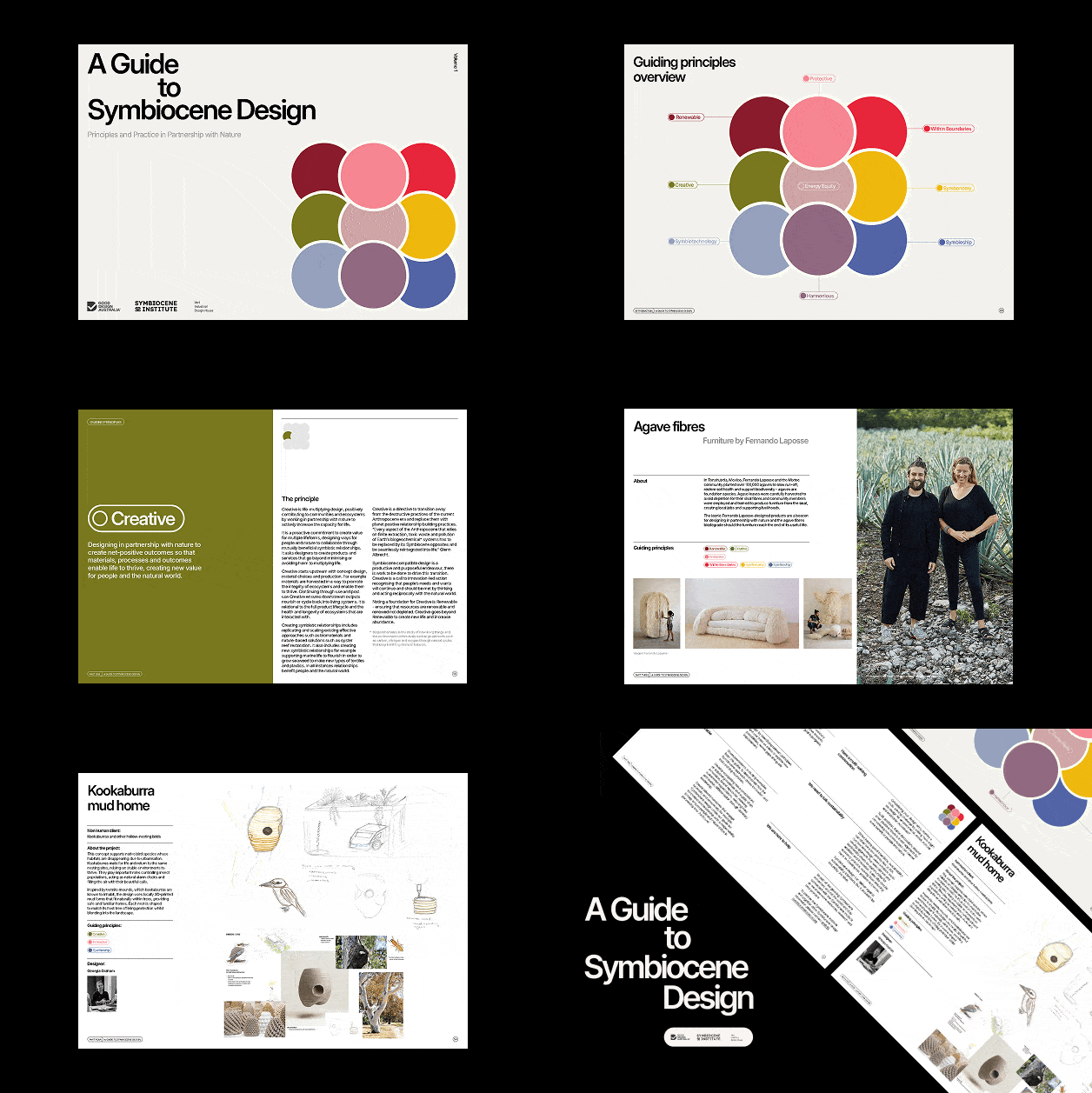
Image: Symbiocene Institute
GDA: What role does A Guide to Symbiocene Design play in the wider Symbiocene movement?
Andy Marks: The Symbiocene proposes that a shift is needed from dominating nature to working in partnership with it. The guide helps people understand how to see nature as a partner, how to draw from nature without depleting it.
The Symbiocene is an emerging global movement. Around the world, the people who are leading on it are designers, architects, engineers as well as artists.
One of the roles of the guide is to reflect this and that the Symbiocene Institute is a hub for this global movement, supporting design now and into the future.
GDA: A Guide to Symbiocene Design arrives at a time when designers already have frameworks like circular economy and regenerative design. What does Symbiocene design add to that toolkit?
Andy Marks: We understand and recognise that there’s a lot of good work being done. There’s also a lot of aspiration out there that isn’t being realised.
Symbiocene design works as an umbrella for a lot of really promising and impactful approaches, including circularity, nature-positive, biophilia, biomimicry and regenerative design.
[Symbiocene design] brings those approaches together and anchors them in what our core belief is: we need to create, or reinforce, mutually beneficial symbiotic relationships with nature.
The approach allows people to multi-solve, to move beyond using a single lens to optimise, which in many instances is profit, often at the expense of nature.
We’re offering a way of analysing problems that designers are trying to solve. A way for designers to look not just at economic benefits, but also environmental, social and cultural benefits.
This helps people understand that their approach can have positive impacts. Not just go from bad to less bad incrementally, but to create positive outcomes through design.
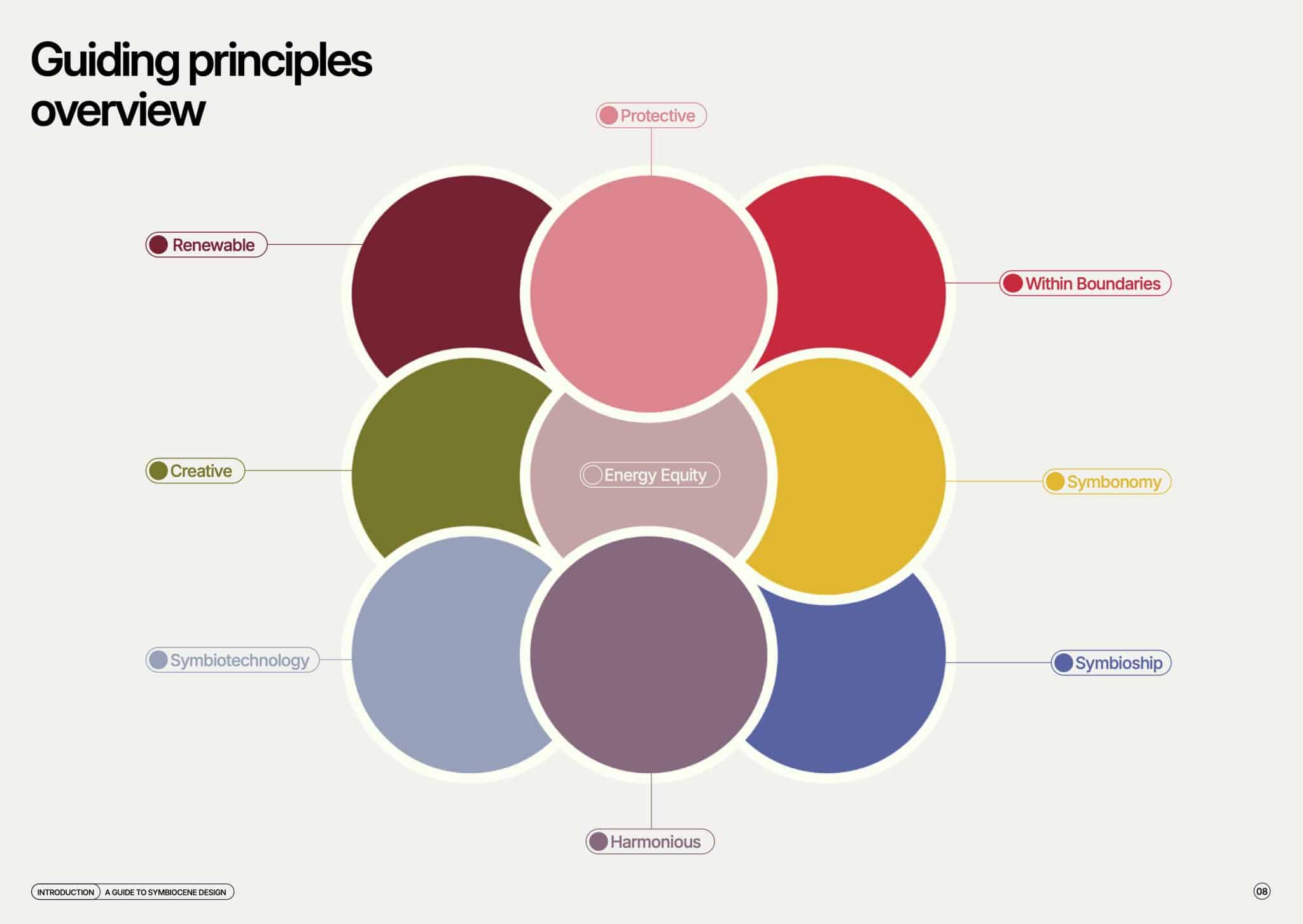
Image: Symbiocene Institute
GDA: The guide was developed in partnership with Good Design Australia and Vert Industrial Design. What did each partner bring to the work?
Andy Marks: The guide has been a process of collaboration over around a 12-month period with our key partners, Good Design Australia and Vert Industrial Design.
It was both a structured and a fluid process in terms of what the different partners could contribute. The partners helped us look at the Symbiocene guiding principles, to explore them,, shape them and see how they can be practically applied.
Vert Industrial Design leaned into their strength in terms of design process and contributed an awful lot throughout, including nine new design concept provocations on how to design in partnership with nature.
Good Design Australia brought a wider understanding of the design world. They helped ensure we were anchored in the practical challenges that designers face. They also helped us understand the wider design landscape – from industrial design and the built environment to policy design, systems and service innovation.
GDA: Why is it important for designers to understand what reconciling human needs and desires with the wellbeing of all life looks like in practice?
Andy Marks: Reconciling human needs and desires with the wellbeing of all life is really the key for this. The way we offer the opportunity for designers to do that is to frame it in something that is both simple yet has complexities.
At its most simple, we use the scientific principle of symbiosis, a foundation for all life. All life on earth is reliant upon relationships with other organisms and natural systems.
This is something that First Nations peoples around the world have always known – that you are in relation to the natural world and need to work at creating partnerships with nature to help ensure life flourishes.
We’re saying to designers here is a way of seeing, here’s a way of thinking and here’s a way of acting.
Symbiosis offers a relational view of the world, a two-way view. It’s rooted in science and it also offers a more emotional component – head, heart and hope.
[The head] offers us a way to see the world and understand that we’re all connected and we’re all dependent upon the natural systems that support life.
[The heart] is the feeling we have that we’re part of something bigger interconnected with nature.
[And the hope] is the Symbiocene as a positive vision of the future, with practical ways to get there. We’re showing what that future could look like.
Hope is absolutely key for people. We need hope that is rooted in practical applications. It’s something the late Joanna Macy calls active hope. It’s not just hoping somebody else will do it, but giving people ways of acting on that hope.
The guide is rich with examples and concepts so that designers can see how the Symbiocene design principles can be applied and be inspired to ask, ‘what’s our version of that?’ We can see pathways through these crises. We can contribute. We have agency. We have the tools. We have methodologies. We have examples. We have inspiration. And therefore we can be more motivated to act and engage our networks and our communities.
GDA: Good Design Australia’s theme for the 2026 Australian Good Design Awards is ‘Design that Leads.’ Why is it important that designers lead the shift to the Symbiocene rather than wait for policy or industry to catch up?
Andy Marks: Designers play a really important role in shaping the world. They are people that understand process,the need for depth in process and to understand the impacts of process.
They create new things. They put new ideas into the world. They point to new directions. They show what is possible and what good can look like and they’re always looking to go beyond, to go better than what they did last time.
Designers are on paths of continual improvement. They’re also very receptive to influences, to soak up what’s going on in the world around them. They have a great perspective to see how change is happening and where change can happen.
At the Symbiocene Institute, we believe everybody needs to play a part. If policy makers see what designers are trying to do, aspiring to do and successfully doing, then they will respond to that.
So designers are catalysts.
The decisions made by designers today shape what gets created, protected and made possible tomorrow. A Guide to Symbiocene Design offers a way to make those decisions in partnership with nature, for a thriving future.
A Guide to Symbiocene Design is available to download now from the Symbiocene Institute.