Redesigning Access to Workplace Justice: The Fair Work Commission’s “Start Online, Stay Online” Service

good-design-award_gold-winner_rgb_blk_logo
  • 2026

  • Service
    Public Sector Services

Designed By:

Commissioned By:

Fair Work Commission

Designed In:

Australia

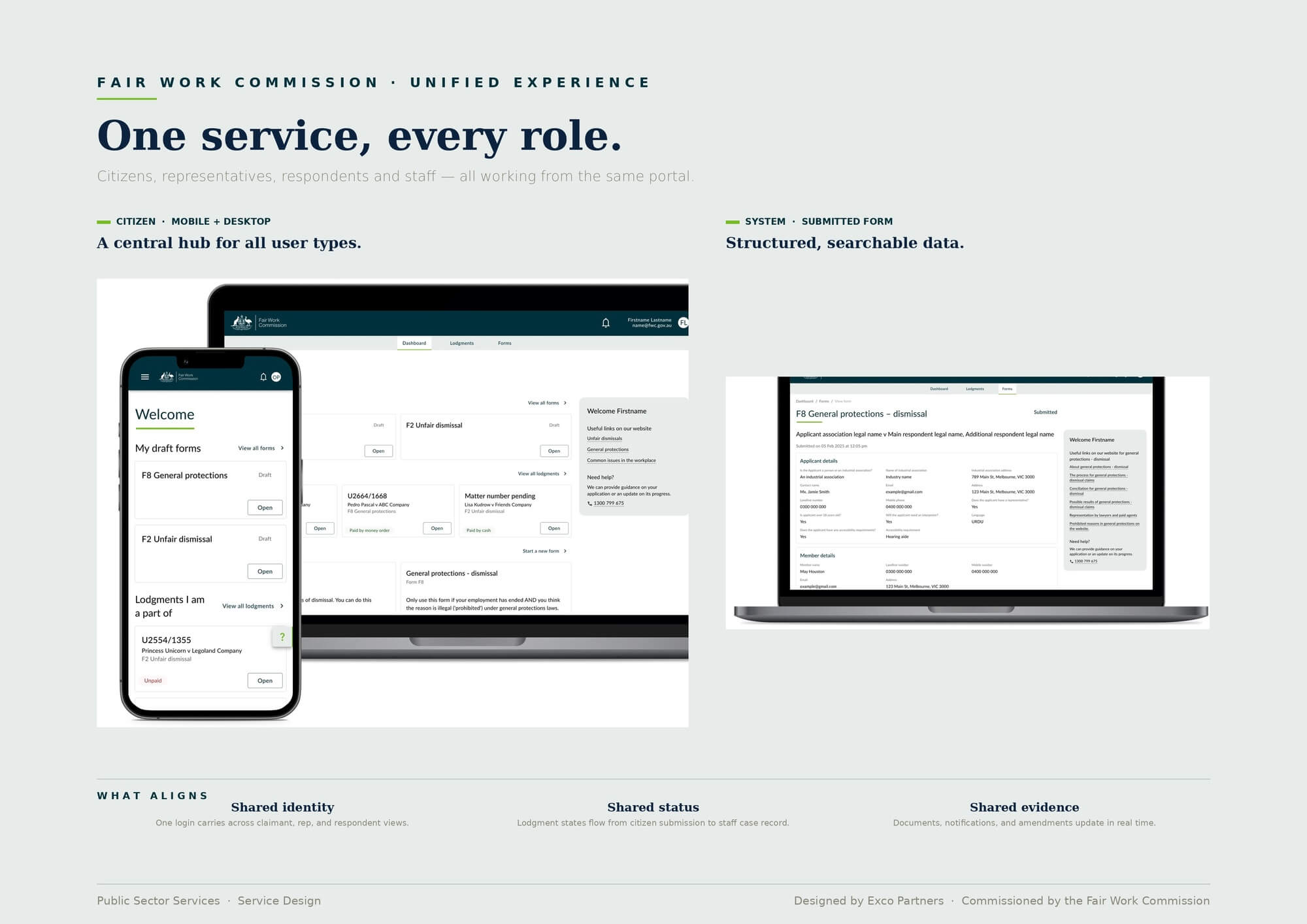
Fair Work Commission, with Exco Partners, redesigned its conciliation service delivering “Start Online, Stay Online”, reframing conciliation as a single, continuous service rather than a set of disconnected transactions. The redesign unifies citizen and staff experiences into coordinated end-to-end digital service, improving consistency, speed and scalability across conciliation case handling.
view website

2.jpg
3.jpg
4.jpg
5.jpg
  • CHALLENGE
  • SOLUTION
  • IMPACT
  • MORE
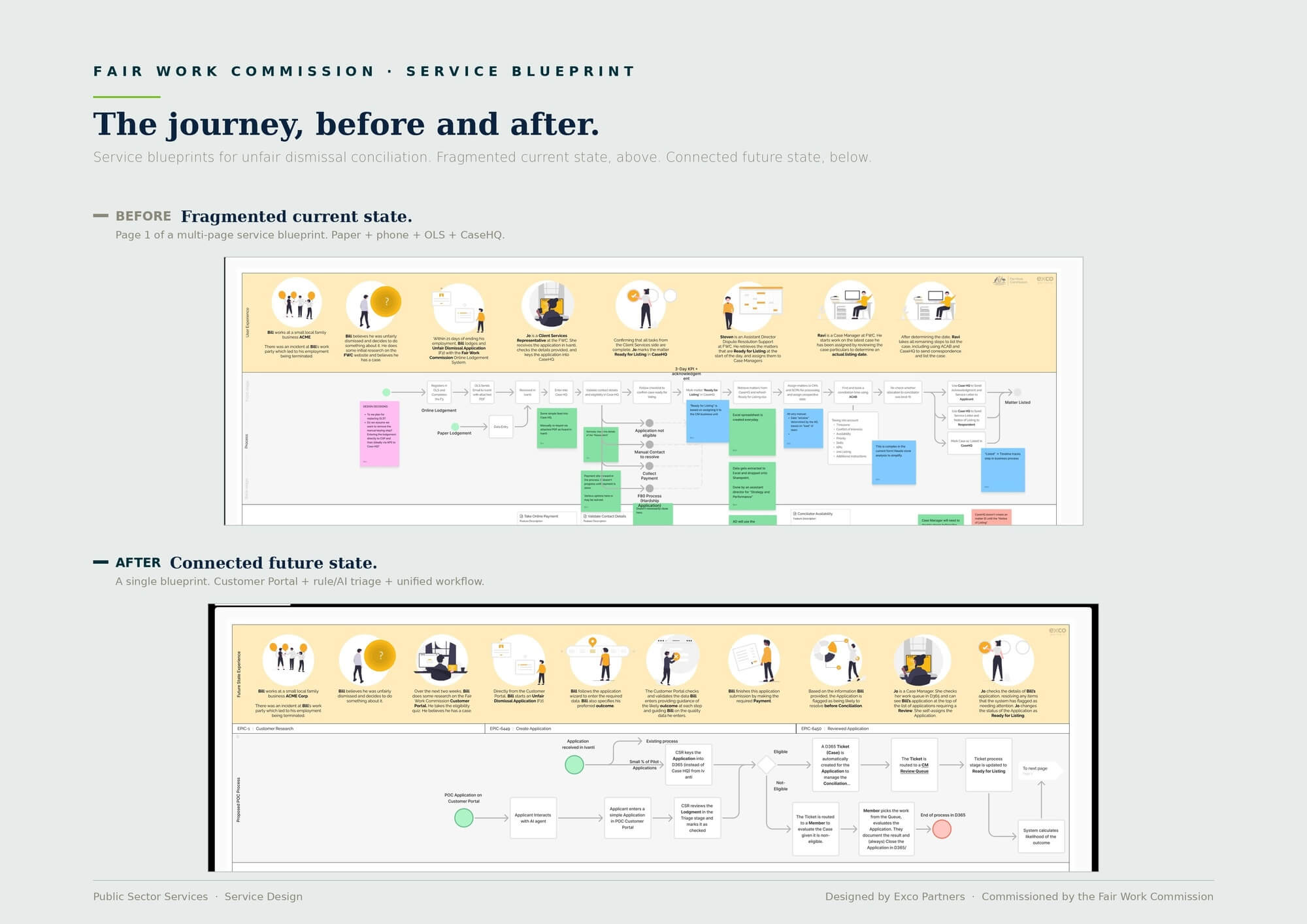
  • The FWC’s conciliation services were constrained by fragmented systems, manual workflows and isolated channels. Matters moved across multiple tools, requiring duplicate data entry, manual triage and phone‑based coordination, leading to delays, inconsistent handling and limited end‑to‑end visibility. Citizens had little clarity on the status or progression of their matter, often relying on phone follow‑ups. Staff managed high case volumes through repetitive processes across systems never designed to operate as one integrated service. While the FWC had already completed journey mapping and service design defining a “Start Online, Stay Online” vision, the challenge was translating this groundwork into an end‑to‑end service.

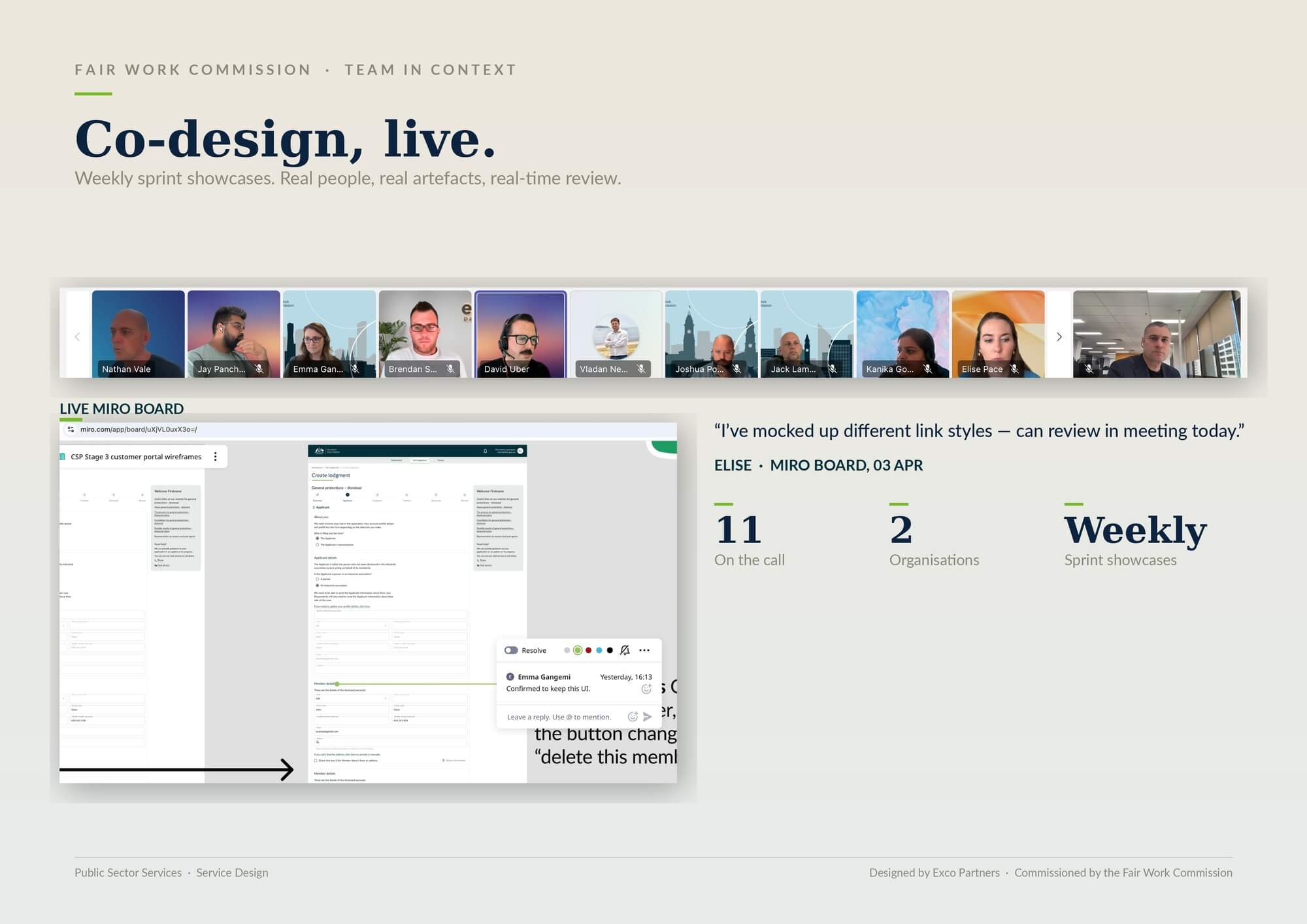
  • The service redesign followed a human‑centred, outcomes‑driven approach guided by clear design principles. The team revisited FWC’s existing journey mapping foundations, encouraging staff to challenge processes and rethink roles. Discovery combined qualitative and quantitative analysis, including staff interviews, service blueprinting, journey mapping, and review of case volumes, hand‑offs and failure points. These insights highlighted fragmentation, duplication and delay. Iterative prototypes were tested with frontline staff and validated through citizen usability testing. Feedback refined intake logic and end‑to‑end workflows, resolving friction before scale. The final solution delivers a unified service that improves visibility, reduces manual effort, and ensures consistent, fair outcomes.

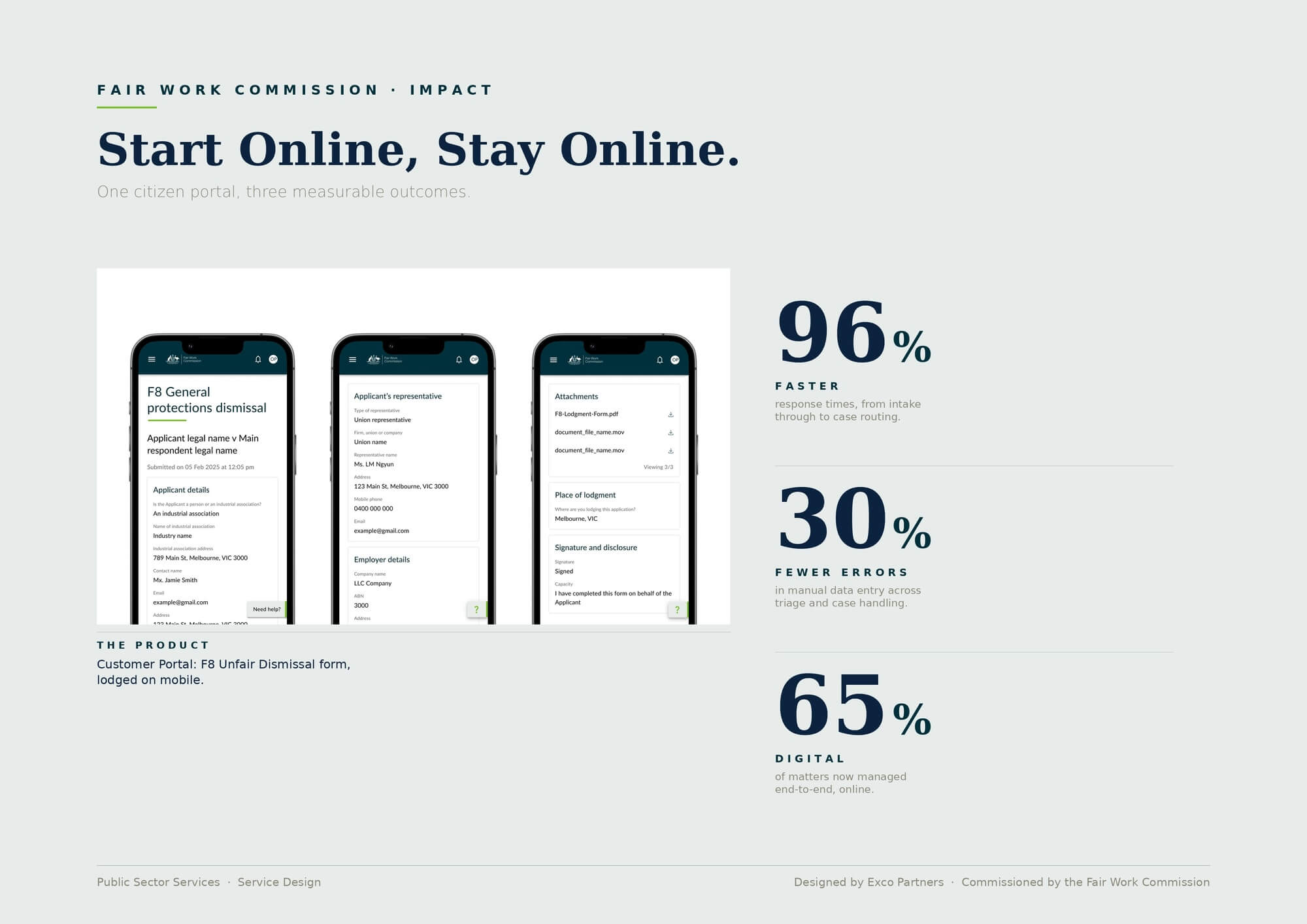
  • The redesigned service has delivered substantial improvements in conciliation speed, quality and scalability. Earlier and more accurate case routing improved response times by up to 96 percent, measured from lodgement to first structured triage and assignment. Manual data entry errors fell by around 30 percent, improving consistency and reducing rework. Within months of launch, more than 65 percent of matters are now managed digitally, reducing reliance on phone channels and ICT support. Clear digital pathways and predictable case progression reduce confusion and anxiety while reinforcing trust in the conciliation process. The Commission can manage caseloads efficiently through redesigned operating models.

  • > End-to-end digital case lodgement and tracking enables citizens to submit and manage cases online with real-time visibility, reducing uncertainty and stress and eliminating the need for follow-up calls.> A unified case management workflow brings intake, triage, scheduling, and resolution into one system, improving consistency, reducing hand-offs, and giving staff greater confidence in decisions.> Intelligent routing supports earlier, more accurate case direction while maintaining human oversight and clear decision accountability balancing efficiency with procedural fairness.> Structured intake design reduces duplication, misrouting, and rework across the lifecycle, increasing reliability and speed of resolution when it matters most.> A transparent decision framework distinguishes automated support from human judgement, strengthening trust in how decisions are made, applied, and reviewed.> Configurable forms and workflows allow policy and process changes to be implemented quickly without redevelopment, enabling the service to adapt as needs evolve.> Accessibility-first design aligned to WCAG standards ensures inclusive participation and equitable access for users with diverse needs.> Operational visibility provides real-time insight into volumes, workload, and bottlenecks, supporting proactive management and continuous improvement.>A scalable, secure, and compliant foundation supports service expansion, regulatory alignment, and long-term public value.