NoMi – XR Collaborative Learning System

good-design-award_winner_rgb_blk_logo
  • 2026

  • Concept Design

Commissioned By:

Chenxi Mao

Tianshu Yuan

Yueru Liu

Designed In:

Australia

Nomi is an XR-powered wearable system designed to support collaborative learning in university classrooms. Through smart glasses and a companion ring, it reveals hidden group dynamics in real time, enabling timely, non-intrusive support that improves participation balance, inclusion, and overall learning experience.

2.jpg
3.jpg
4.jpg
5.jpg
6.jpg
7.jpg
8.jpg
9.jpg
Photo by Beyzaa Yurtkuran on Pexels. Source: https://www.pexels.com/photo/smiling-woman-in-sunlight-18424585/
  • CHALLENGE
  • SOLUTION
  • IMPACT
  • MORE
  • Collaborative learning environments in university classrooms often mask issues such as participation imbalance, communication breakdown, and unaddressed conflict. Traditional tools prioritise efficiency but overlook the social dynamics that shape effective teamwork, leaving quieter voices unheard and limiting group outcomes. Neurodivergent and international students face additional barriers to participation.The project addresses these challenges by designing a system that reveals and supports invisible classroom dynamics in real time without disrupting natural interaction. It integrates behavioural awareness into collaboration in an inclusive, intuitive, and non-intrusive way, ensuring support enhances rather than replaces human relationships in learning.

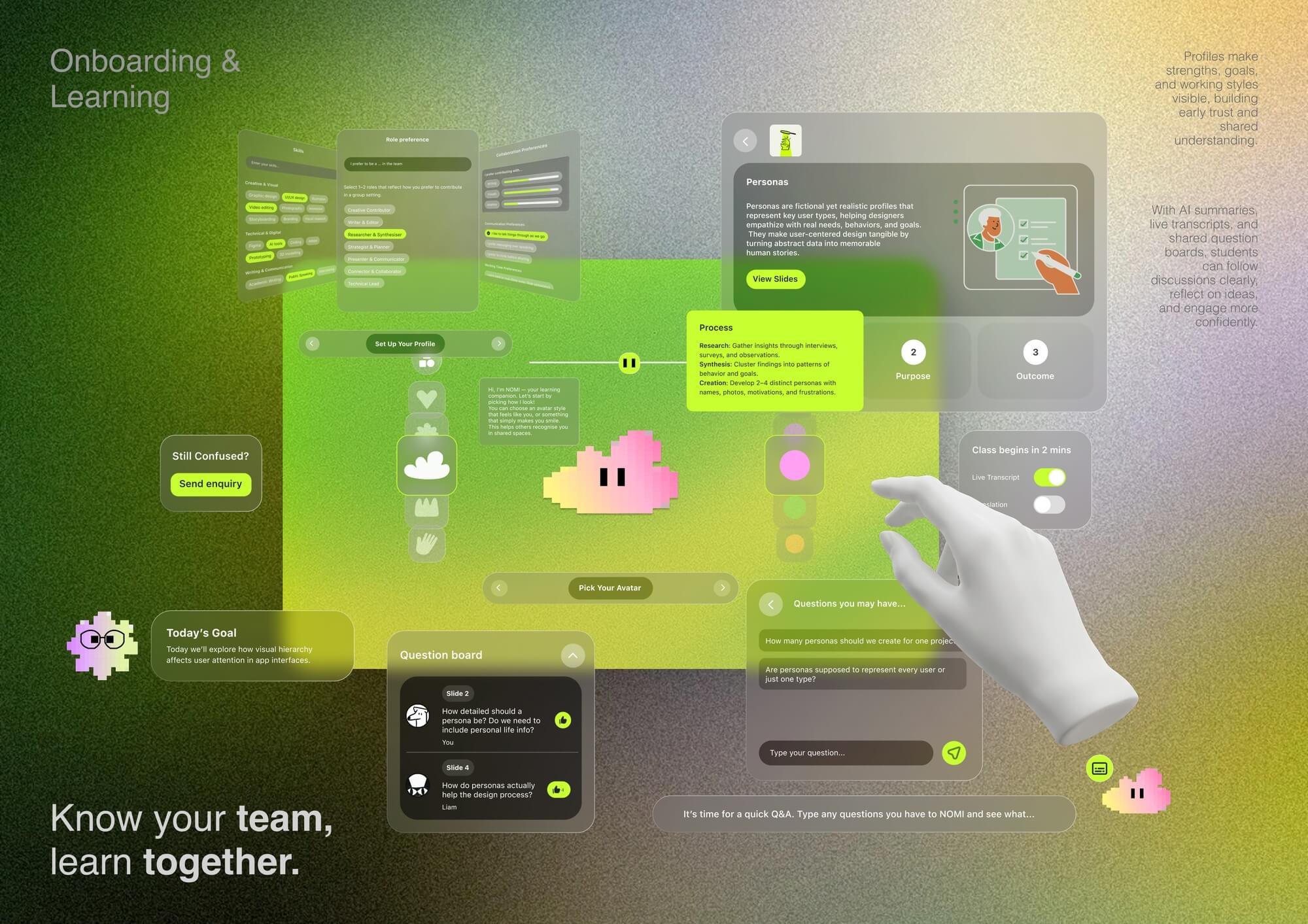
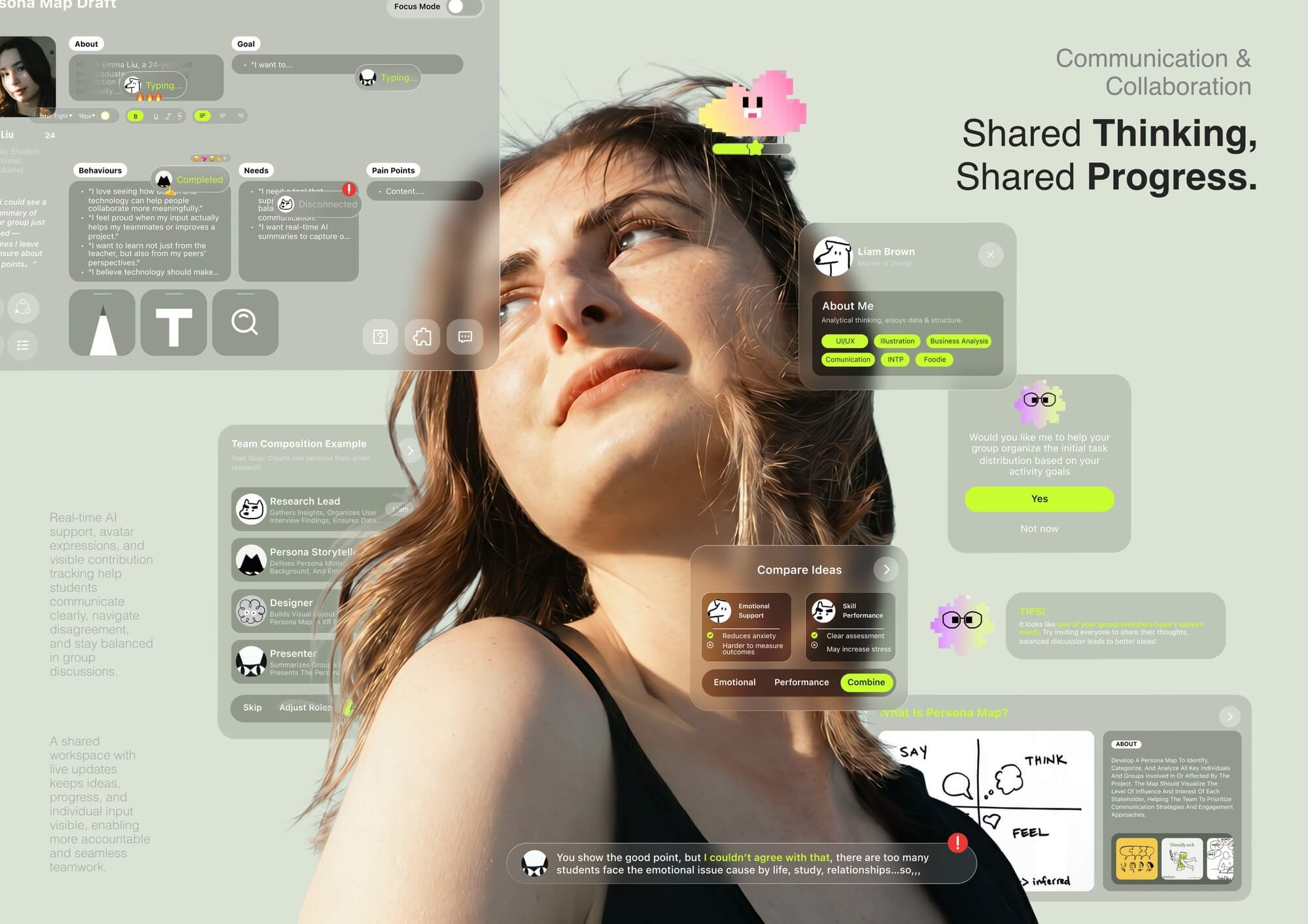
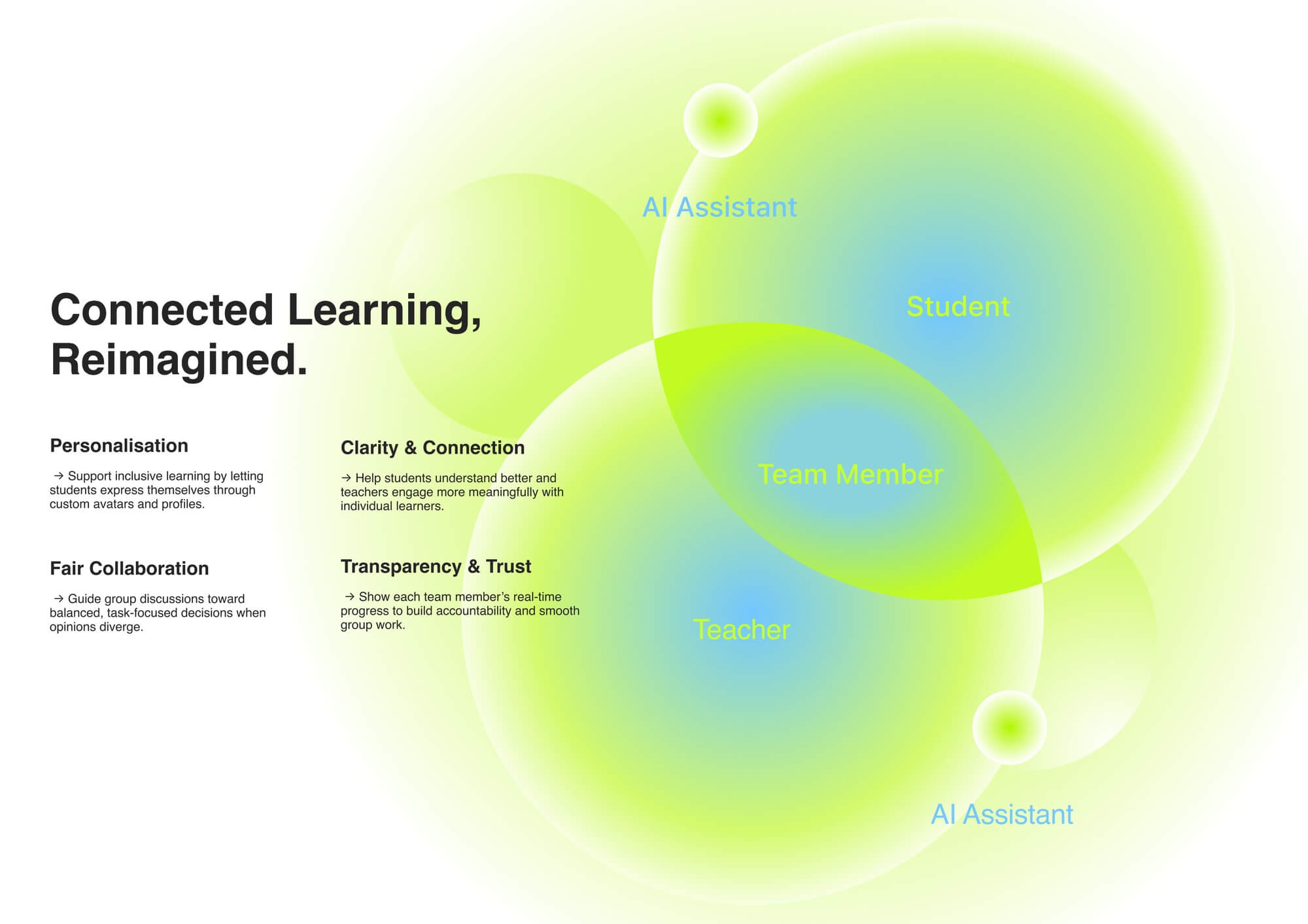
  • Nomi responds to this challenge by integrating immersive XR collaboration with an AI-driven interaction layer that enhances group dynamics. Research with university educators and students revealed that breakdowns in collaboration are primarily relational, with many students feeling unseen rather than unsupported academically.Nomi was developed as a system supporting participation at both individual and group levels, structured around onboarding for role clarity, a shared XR workspace for real-time co-creation, and an AI layer that surfaces communication patterns. Delivered through smart glasses and a companion ring, it provides real-time, non-intrusive guidance, enabling balanced participation, clearer communication, and more inclusive collaboration.

  • Nomi redefines digital collaboration by addressing the social dynamics that underpin effective teamwork. As XR, wearable devices, and AI tools become more accessible in education, most systems still prioritise efficiency over human connection. Nomi responds by making participation safer and group dynamics visible, improving equity, communication clarity, and cohesion, particularly for neurodivergent and international students.Designed for institutional deployment, it supports equitable access at scale. Aligned with SDG 4 (Quality Education) and SDG 10 (Reduced Inequalities), Nomi introduces a new paradigm where behavioural awareness and AI-driven insight enhance not only productivity, but the quality of human interaction.

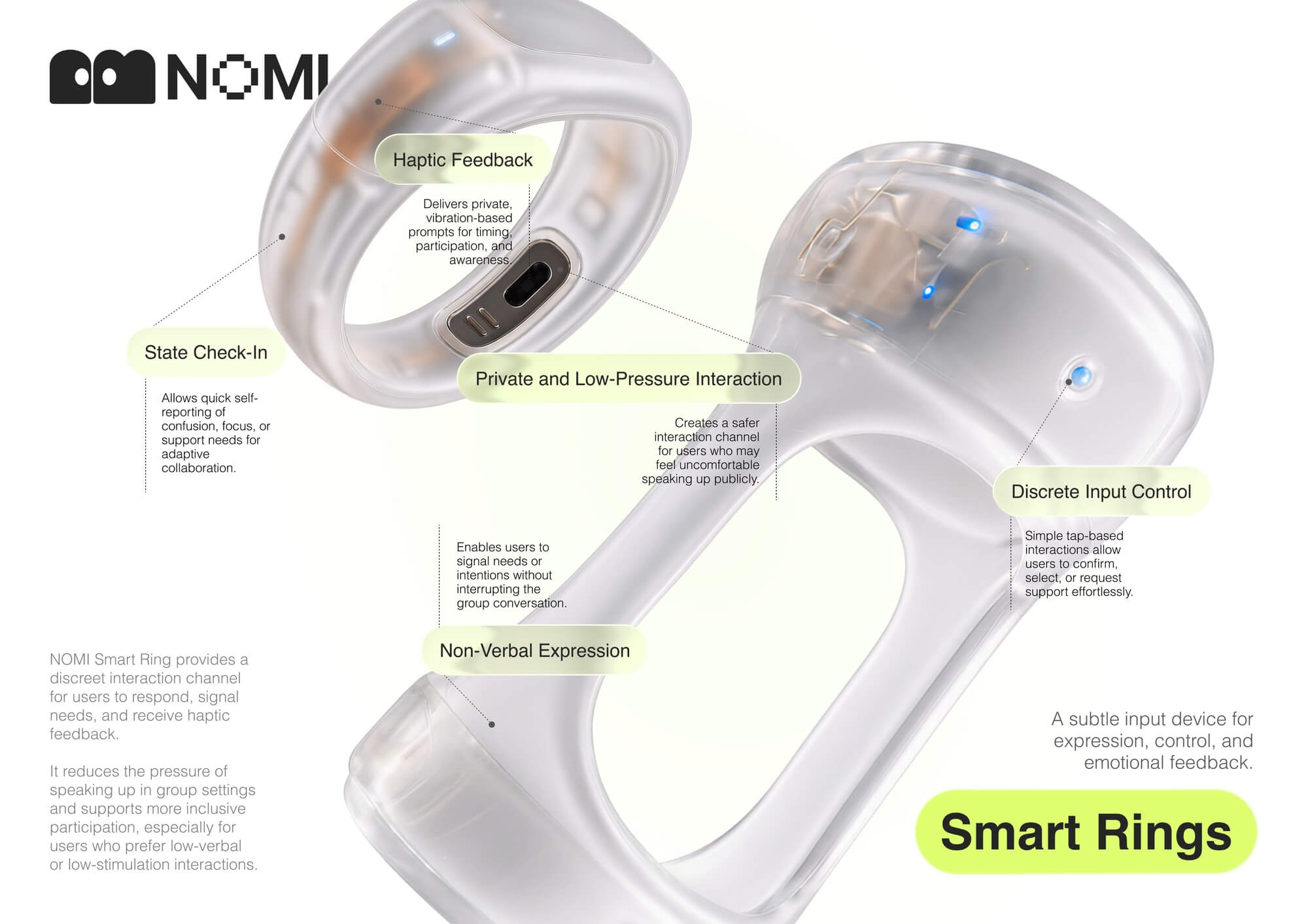
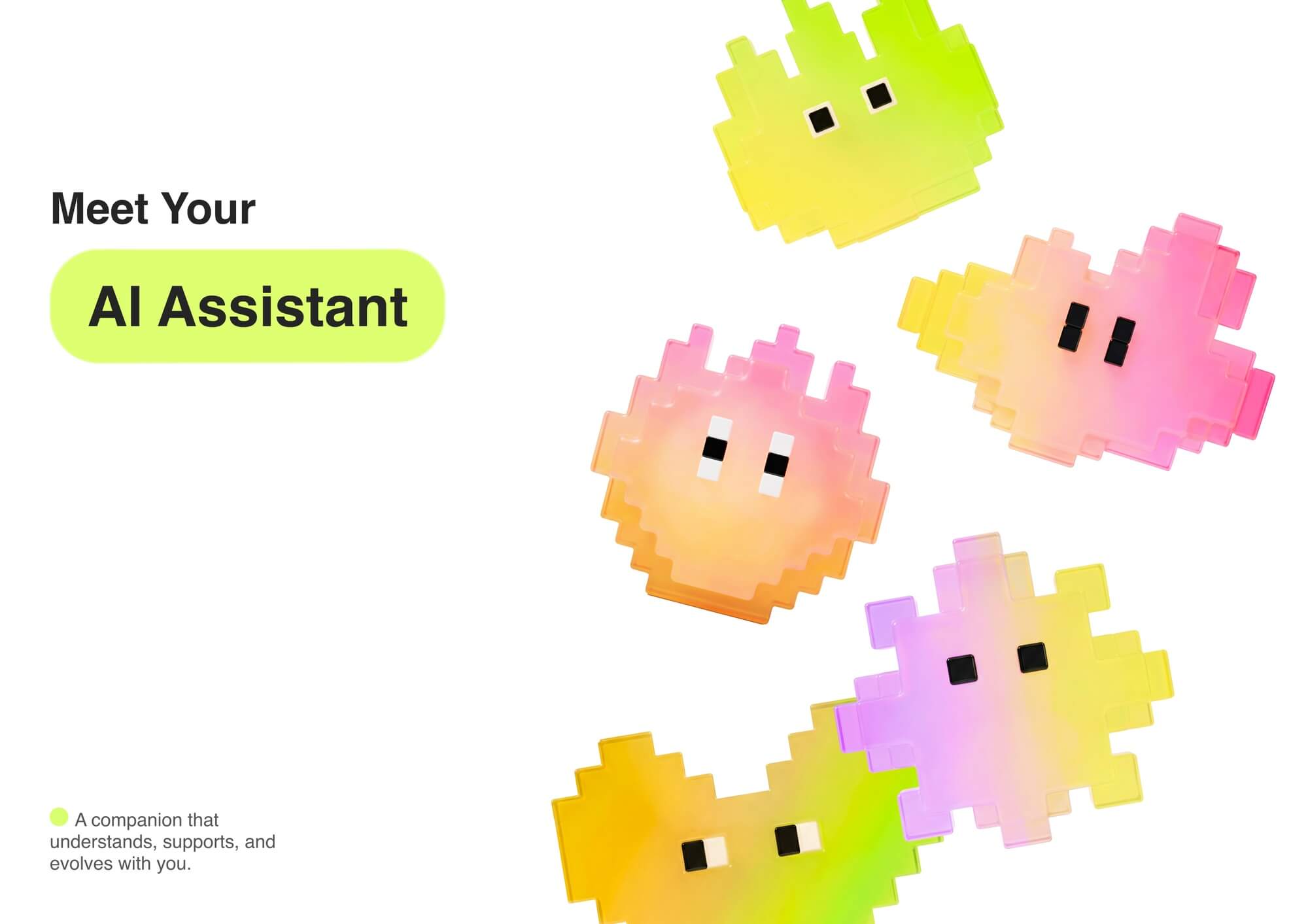
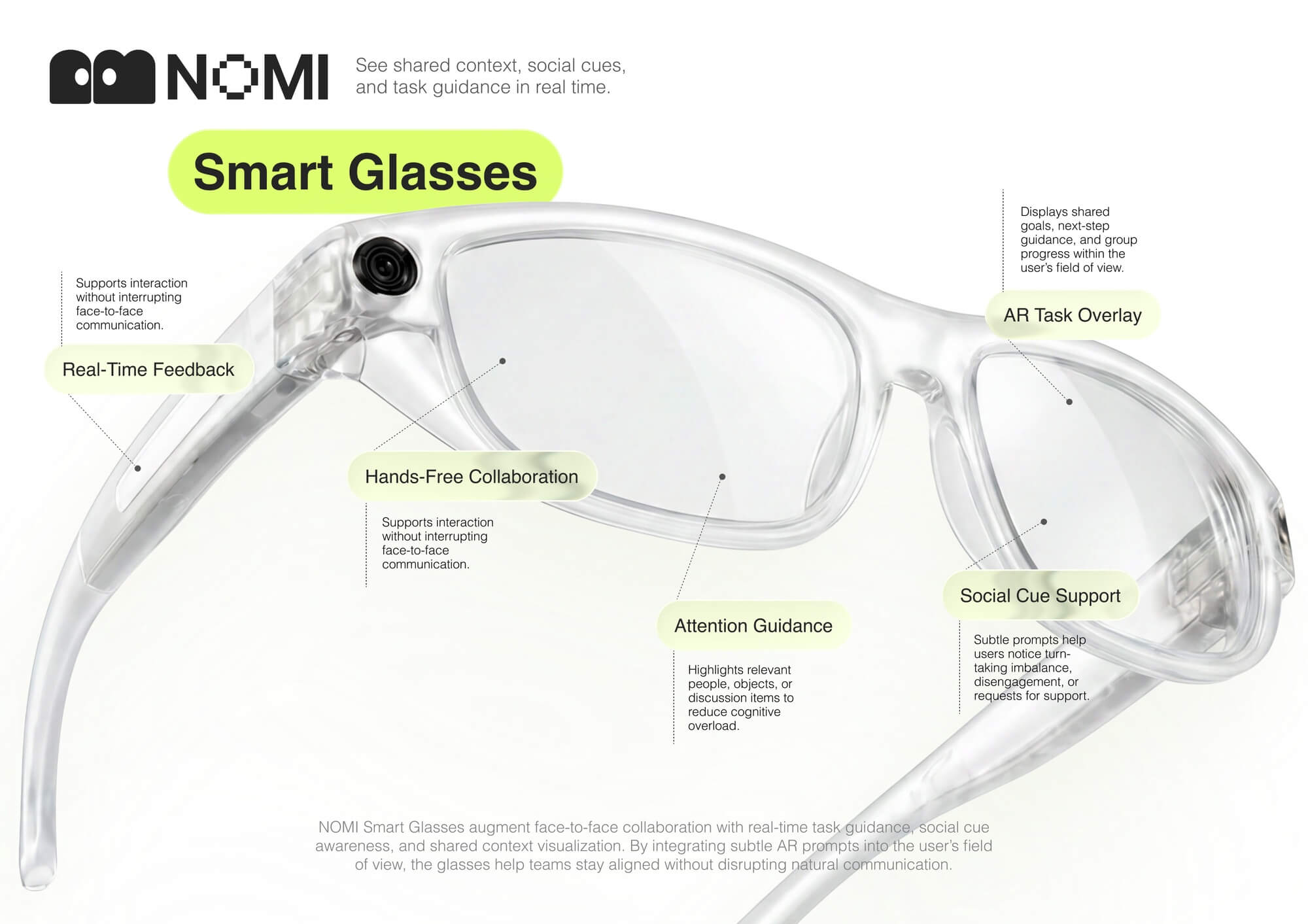
  • NoMi’s wearable system centres on two devices working in tandem: smart glasses and a companion ring.The glasses overlay real-time AR guidance: including AI-generated lecture summaries, live transcripts, shared question boards, and group progress tracking, directly within the wearer’s field of view, supporting understanding without breaking face-to-face interaction. The ring provides a private haptic input channel, allowing students to signal confusion, agreement, or support needs through discreet tap gestures that remain invisible to others in the room. Together, they give every student a private voice: a participation channel that is especially transformative for neurodivergent and international students who face compounding barriers to speaking up.Building on this, an avatar and profile system enables students to define their strengths, goals, and collaboration preferences, establishing psychological safety before any group work begins. During collaboration, NoMi’s AI layer monitors group dynamics in real time, detecting participation imbalances and diverging perspectives. It responds through subtle, neutral prompts delivered via the glasses, supporting conflict mediation without interrupting the flow of discussion.A shared AR workspace makes each individual contribution visible to the group, ensuring that otherwise unseen effort is recognised. This transparency strengthens accountability while avoiding the need for overt monitoring or surveillance.