Designing a Better Policy Framework

good-design-award_gold-winner_rgb_blk_logo

Amid a backdrop of rapid scientific and technological advancements and a complex health landscape, the Department of Health and Aged Care (DoHAC) and Tobias reimagined departmental policy design and development through the Designing Better Policy initiative, creating an adaptive, data-driven, human-centred framework to meet evolving health sector needs at scale.
view website

1.jpg
2.jpg
3.jpg
4.jpg
5.jpg
  • CHALLENGE
  • SOLUTION
  • IMPACT
  • MORE
  • Government policy is shaped within complex, fragmented systems, tight timelines, and stakeholder scrutiny. Impediments to effective decision-making and innovation include inconsistent design and evaluation approaches across policy teams, resulting in fragmented insights and difficulties comparing options. Barriers to effective team and stakeholder collaboration hinder aligned and cohesive policy development. These factors contribute to low confidence and doubt in the accuracy, completeness, and relevance of data. The challenge: create a repeatable, human-centred, evidence-based policy process that could be operationalised at scale. Success required an approach acknowledging current practices, co-created practical solutions with policy teams, and demonstrated value in real-world settings.

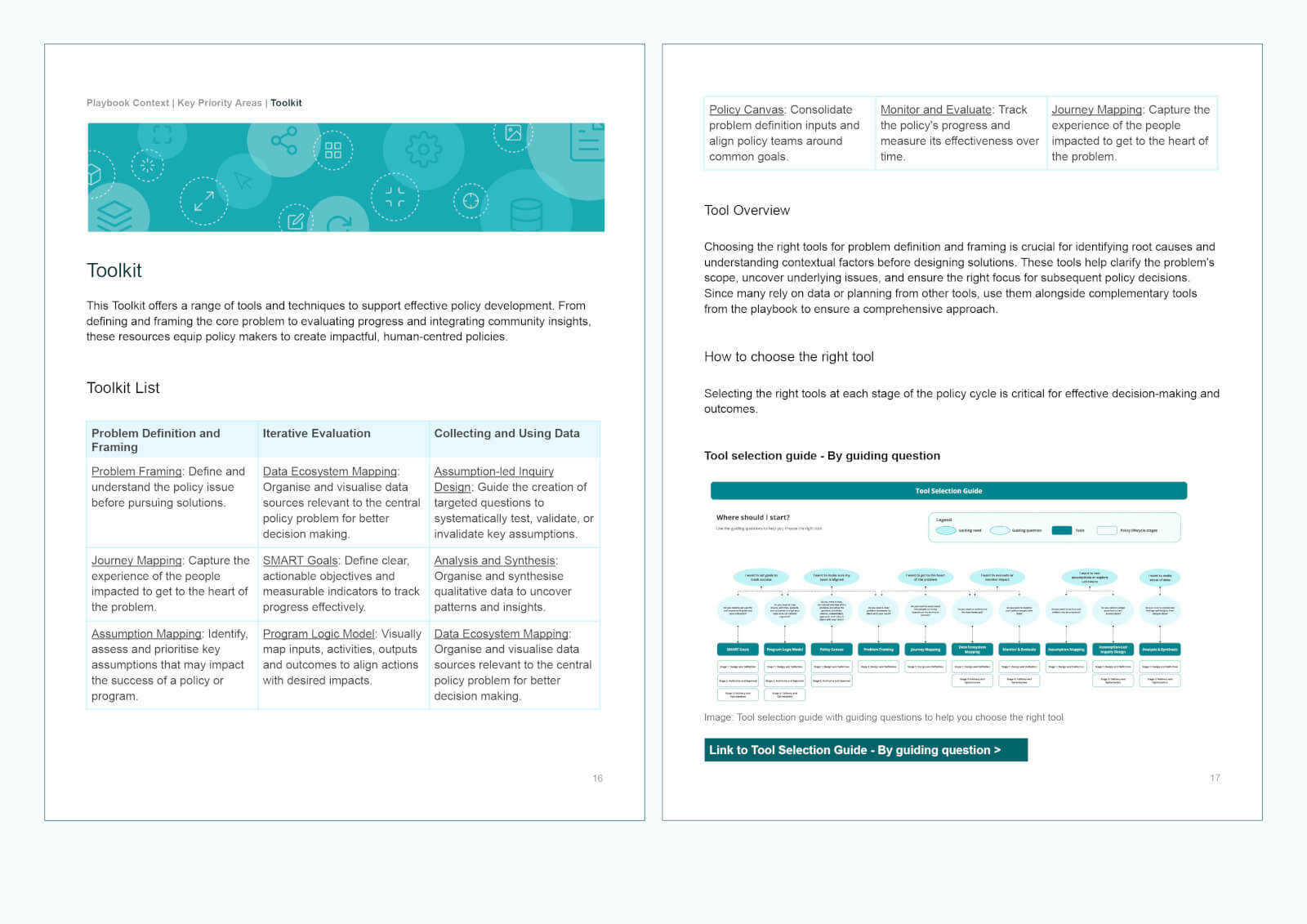
  • The Designing Better Policy initiative co-designed a framework for delivering better digital health policy. Current state discovery identified 28 pain points and 34 opportunities for transformation. The team prototyped a future-state Policy Lifecycle Framework and created the Designing Better Policy Playbook, a digital and printable resource with custom tools, templates, and guides, validated through iterative testing on a live policy initiative. It delivered a Roadmap for Change for transitioning to an ambitious future state. Training Workshops complemented these efforts, embedding human-centred design and evaluative thinking capabilities. The playbook provides practical, data-driven, repeatable approaches for better, more responsive policy.

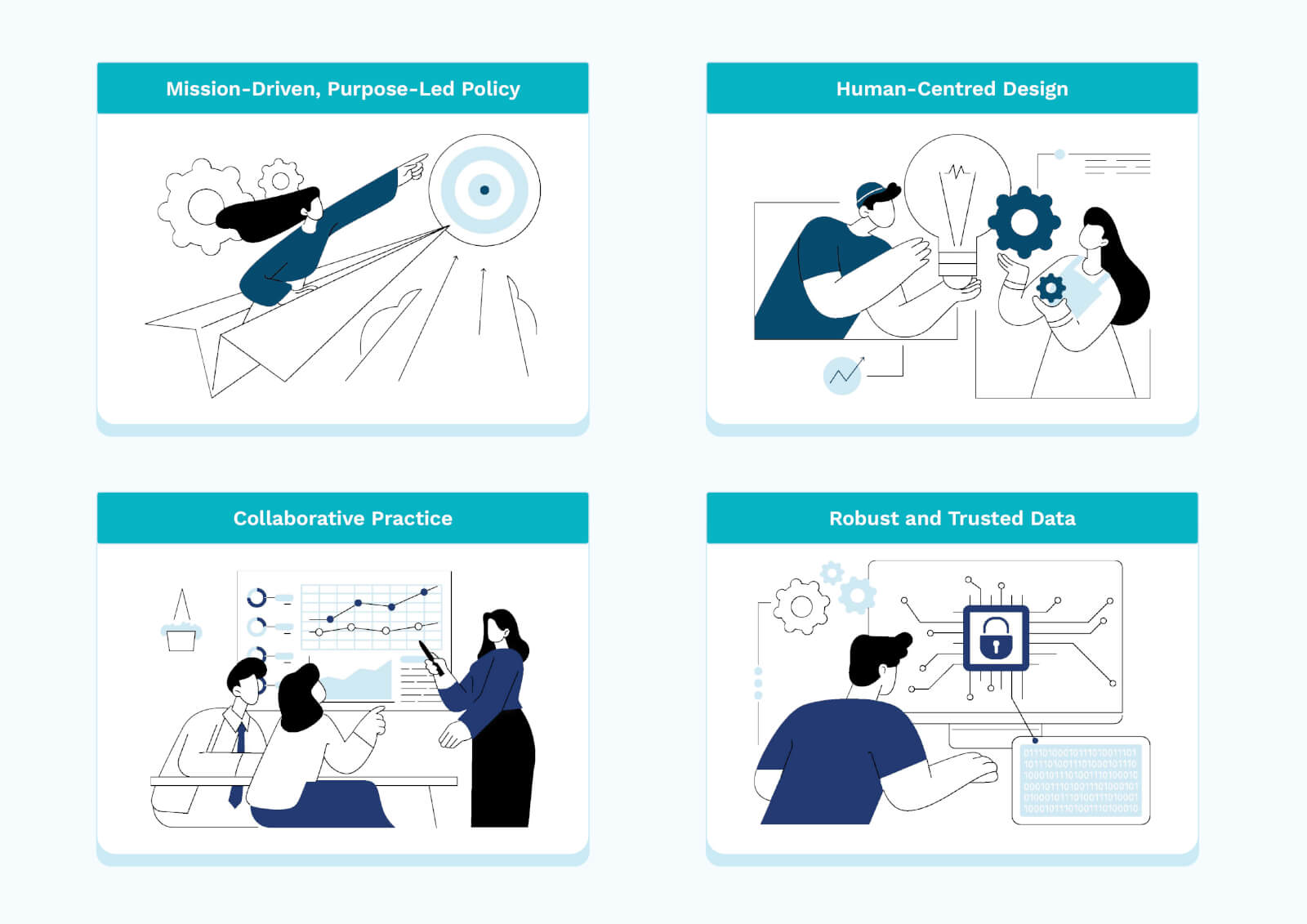
  • The Better Policy Framework is a blueprint for embedding design at the heart of public policy. It demonstrates that design can drive measurable, strategic outcomes in complex government settings. By creating an adaptive toolkit for iterative evidence building and a systems-thinking approach, this strategy sets a new benchmark for design-led transformation and has the potential to inspire systemic change across the public sector. It ensures that valuable ideas are explored early, data is traceable, and solutions based on evidence are iterated and stage-gated to mitigate risks, ultimately enabling high-quality decision-making in digital health, which benefits the Australian public.

  • Future-state methodology and tools were piloted on a ‘live’ policy initiative, Sharing by Default. This bill was successfully passed in February 2025. Design Approach - Human-centred policy co-design: All the processes, tools, and resources created with people who use them – policy advisors, analysts, and delivery teams. - End-to-end policy lifecycle mapping: The team mapped the current and future state policy lifecycle, surfacing 28 pain points and 34 opportunity areas. - Capability uplift: Integrated workshops and the Tobias Learning Lab created momentum and mindset shift toward design-led practices. - Tested & iterated: Playbook and tools validated through four sprint-cycles, across concept testing, mid-fidelity and hi-fidelity prototypes. - Scalable & adaptable: The process and outputs were designed to be replicated across teams and departments, supporting long-term transformation. Design Solution Designing Better Policy Playbook: digital & accessible toolkits hosted on DoHAC’s SharePoint with downloadable PDF versions - 10 custom tools: journey mapping templates, SMART goals, policy canvas, program logic models, and evaluation tools – with instructions and Miro boards - Benefits & Risks Map and Benefits Modelling Tool to inform Policy Impact Analysis: These tools provide transparent, evidence-based insights into an initiative’s potential, scenario testing, and ongoing evaluation. - Strategic, horizon-based roadmap for change: to guide implementation of the future state policy lifecycle over three horizons