D.F.S Dragonfly Sanctuary

good-design-award_gold-winner_rgb_blk_logo
  • 2026

  • Concept Design

Designed In:

Taiwan

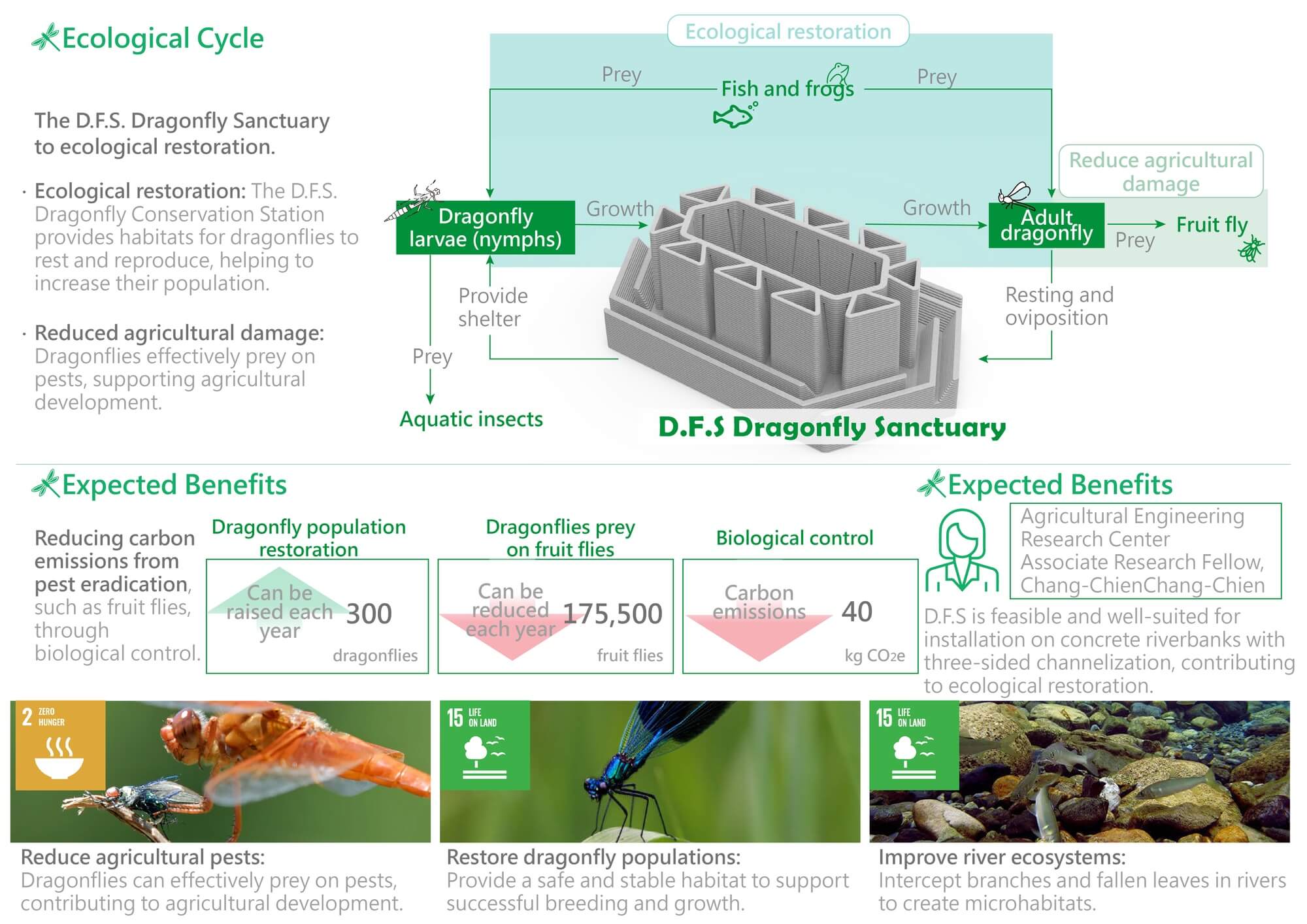
D.F.S Dragonfly Sanctuary is a modular ecological device installed in concrete riverbanks to restore dragonfly habitats. It creates safe breeding and growth environments, increasing survival rates and supporting natural pest control, benefiting both biodiversity and agriculture.


2.jpg
3.jpg
4.jpg
5.jpg
6.jpg
7.jpg
8.jpg
  • CHALLENGE
  • SOLUTION
  • IMPACT
  • MORE
  • Concrete riverbank construction for flood control has severely degraded aquatic ecosystems, removing natural substrates like plants and fallen leaves essential for dragonfly reproduction. Existing ecological restoration solutions require large-scale reconstruction, costing USD 320,000–3.2 million and taking months to over a year, often causing further environmental disturbance.The challenge was to develop a low-cost, easily deployable solution that can be integrated into existing hardened riverbanks without major construction, while effectively restoring habitats and improving biodiversity.

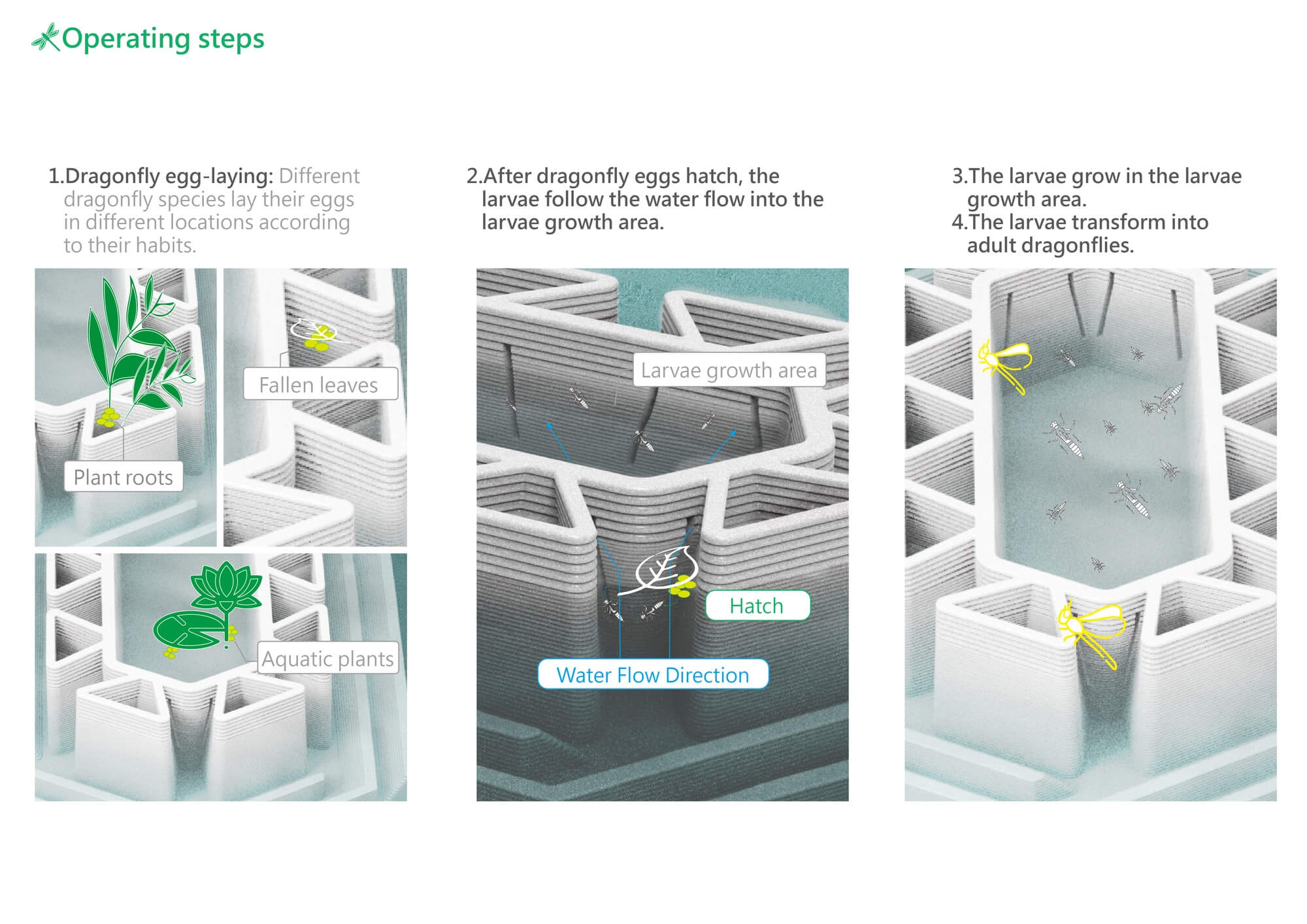
  • The D.F.S Dragonfly Sanctuary is designed as an add-on structure for concrete riverbanks. Its form slows water flow and captures fallen leaves, creating natural egg-laying sites. A guided flow system carries larvae into a protected growth chamber with narrow openings that block predators.The design was validated through water flow testing, larval rearing experiments, and full-scale 3D-printed concrete prototypes. These tests confirmed leaf accumulation, suitable passage dimensions, and real-world manufacturability, ensuring both ecological effectiveness and practical feasibility.

  • D.F.S enhances biodiversity by restoring dragonfly populations, with each unit supporting up to 300 adults annually and increasing larval survival by up to 50%. As natural predators, dragonflies help control pests such as mosquitoes and fruit flies, reducing reliance on chemical pesticides.Environmentally, the system supports ecological restoration with minimal intervention and incorporates carbon-sequestering materials. Socially, it raises awareness of river habitat degradation and promotes sustainable, nature-based solutions for climate adaptation and ecosystem recovery.

  • .Modular design for easy installation in existing concrete riverbanks.Water flow control to trap leaves and create breeding habitats.Protected larval growth chamber with predator-blocking gaps.Supports aquatic plant growth for ecological diversity.Constructed using concrete 3D printing for scalability and adaptability.Low-cost alternative to large-scale river restoration projects