Mark Burry AO – 2025 Australian Design Prize
- Published on: 28 October 2025
Share
THE AUSTRALIAN DESIGN PRIZE WAS ESTABLISHED TO RECOGNISE INDIVIDUAL DESIGNERS WHO ARE MAKING, OR HAVE MADE, A SIGNIFICANT IMPACT IN AUSTRALIAN DESIGN OVER THE COURSE OF THEIR CAREER.
Professor Mark Burry AO is one of Australia’s most influential design thinkers. He is an architect by trade, but a true designer in his work. Mark is an educator and research leader who has spent his career connecting architecture, technology and design research, thriving where they meet.
Burry’s skills have taken him from the Sagrada Família in Barcelona to being the Founding Director of Swinburne’s Smart Cities Research Institute. Across all of his work, his bottom line is simple.
Design should serve people and be made with them.
A geometrical beginning
We sat down with Professor Mark Burry AO about his career, spanning complex geometry, parametric thinking and city-scale participation.
“I’m supposed to be semi-retired,” he laughed, “but I’m busier than ever.”
Now based in Adelaide, “Australia’s best kept secret” as per Mark, Professor Burry looked back on a career that began in Barcelona in 1979. As a young architect from New Zealand, he joined Antoni Gaudí’s unfinished masterpiece as an intern, the Sagrada Família.
“It’s the only time I’ve actually been in the shadow of a genius,” he reflected.
“Gaudí was able to embrace every attribute of architecture with equal flair, aesthetic, philosophical, engineering, the science of materials, composition. You can’t help but be changed by that.”
At the time, the team was rebuilding from fragments, boxes of broken plaster models, geometry puzzles and memories of Gaudí’s methods. Burry was tasked with translating them into information modern builders could use.
“I had to find the geometries that would intersect and give curves exactly as we could see in the models. Doing it by hand would take weeks. Then I thought, ‘surely that’s what the computer should be doing’.”
When existing architecture software fell short, he turned to tools used by boat and aircraft designers.
“I adapted it so that it was architecturally focused. That’s how I got into computation, because I had a complex project that demanded it.”

The Sagrada Família. Image: Supplied
The father of parametric design
By necessity, Burry became one of the first architects to use parametric design – a flexible, data-driven approach now standard in contemporary practice.
He explained the principles of parametric design as:
“A table has characteristics we call parameters: the length, width and height. A parametric design is a flexible model where those dimensions can change. If you say, ‘What if it was 100mm wider?’ I just type in the revised dimension, and the model reworks itself.”
That same principle, designing for adaptability, can be applied to cities.
“Everybody works parametrically now.
“That’s why I moved into smart cities and big data. The same techniques can be scaled up to more complex systems, for what I call ‘parametric urbanism’.”
Mark’s work in parametric design was ahead of its time.
By combining geometry, computation and creativity, he helped shape a new way of thinking that is now embedded in architecture across the world. His pioneering approach to digital modelling has become part of everyday design practice.
Founding the Smart Cities Research Institute
At Swinburne University of Technology, Burry founded the Smart Cities Research Institute, later evolving into the Innovative Planet Research Institute. His title remains Adjunct Professor of Urban Futures.
The Institute’s ethos was to move beyond consultation into genuine collaboration.
“It’s cities and places moving from being designed for people, to being designed with people,” he explained.
“It’s not citizen engagement. It’s citizen participation.”
Through data and design, the Institute worked to dissolve gaps between disciplines to create more cohesive visions of urban life.
“Urbanism is a mix of not just design, but sociology, history, philosophy, economics and engineering, all the things you need to know about to understand how a city really works.
“The role of the Institute was to make sure people weren’t stuck in their silos. If you came from a design background, you’d have access to data scientists, sociologists, health experts and traffic engineers, so together we could form a more cohesive view of what the city should do.
“If you leave the city in the hands of traffic engineers,” he added as an example, “you get cities that prioritise cars. We accommodate cycling rather than celebrate it, when in fact every person on a bicycle is taking a car off the road.”
One of the Institute’s key outcomes was the creation of iHub, a state-of-the-art collaborative facility designed to help participants make smarter, data-driven decisions in urban planning, policy and design.
“It’s a facility with super high-definition monitors. Anyone in the space can put what’s on their laptop or tablet up at the same time,” Burry explained.
“In the old days, designers would put their work up together, not a sequence of slides, but a story. With today’s technology, we can do that digitally. You can see everyone’s ideas at once.”
Back to his roots
While his leadership at Swinburne’s Smart Cities Research Institute focused on urban futures and citizen participation, Professor Burry’s personal research continues to return to a deeply human scale of affordable, community-led housing.
“In my own research, I’ve gone back to my roots, finding affordable housing solutions for people from low socioeconomic backgrounds.
“I started my career in the Western Isles of Scotland, the most outlying islands to the west. In the 1980s they didn’t even have a secondary school. Kids had to travel nine hours to the mainland and live there for the term. People were still living in single-room homes with no sanitation, unbelievable in the UK at that time.
“We were building housing, and that’s when I first learned it’s better to work with the community than for the community, if you really want them to have ownership and appreciation for whatever architectural solution you’re giving them.”
Reimagining Australian cities
Burry is optimistic about what Australian cities could be, and frank about what holds them back.
“Given the enormous talent we have, from engineering to design, we don’t see those talents being used to the max. We’re a bureaucratic society. We’re risk averse.”
He points to the importance of long-term thinking, citing examples like Adelaide’s O-Bahn Busway and early data-led planning research of Ernest Fooks dating back to 1946.
“We know what to do. We just haven’t worked out how to do it yet. Urbanism is long-term, but our political system is short-term.”

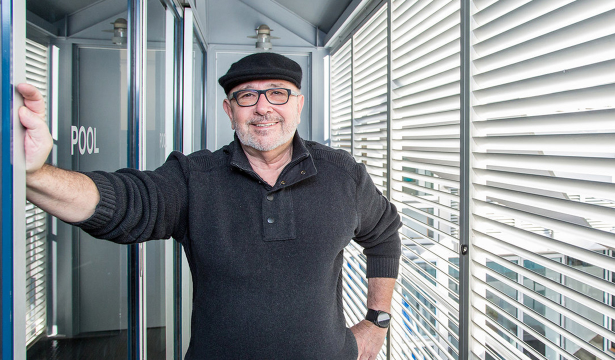
Mark Burry AO – 2025 Australian Design Prize. Image: Supplied
The edge of design
For Burry, data matters most when it fuels imagination.
“Engineers will drill down to find the best outcome, that’s analysis. Designers synthesize. They use data to generate options and weigh the pros and cons.”
The designer’s edge, he revealed, is spotting the “unknown unknowns”: the patterns no algorithm can yet anticipate.
Across universities, cities and decades, his ethos is constant. Great design lives where history, philosophy and technology meet.
He recalled a time when he ran a transdisciplinary studio with architects, fashion designers, graphic designers, engineers, industrial designers, all working on an urban or architectural project.
“Each learned what the other lacked. The architects were in awe of the fashion designers’ conceptual flair, and the fashion designers were fascinated by the architects’ ability to unpack ideas into concepts.”
That cross-pollination has shaped his practice and his advice.
“Be aware of the science and the engineering of design. You don’t have to embrace it, but if you’re going to reject it, do it knowingly.”
He also advised young designers who want to create work that has long-term impact to take history and philosophy seriously.
“All designers should have an absolute grounding in the history of their field and the philosophical and, where relevant, sociological impact of what they do, as well as their creative brain.
“To work without precedent, or without respect for the work that has gone before you, is risk and ignorance. You won’t get the most out of your talent.”
Identity and impact
Though a registered architect, Burry sees himself first and foremost as a designer.
“I’ve spent my entire career thinking about design,” he reflected.
Mark’s identity underscores a deep reverence for Gaudí, the artist who made architecture feel alive.
“He was a sculptor who realised sculpting alone wasn’t appropriate for buildings the size of cathedrals.
“So he turned to mathematics and geometry. That’s the balance I’ve always admired, art meeting logic.”
In many ways, Professor Mark Burry AO carries forward the same spirit that defined Antoni Gaudí’s life’s work. Both seek beauty through precision and find meaning in the meeting of art, mathematics and human experience.

Mark Burry AO – 2025 Australian Design Prize. Image: Supplied
The continuum of design
Mark Burry designs for the shared intelligence of our time, proving that when art and logic, past and future, human and digital meet, design becomes something enduring.
But beyond the technology lies his greater contribution, a belief that design is shared pursuit.
Whether shaping basilicas, cities or systems, Burry’s legacy reminds us that we can’t create for people, because we are the people. Design, at its best, is something we build together.
Good Design Australia congratulates and thanks Professor Mark Burry AO for his lifelong contribution to advancing design as a collaborative, civic and human pursuit.