2025 Indigenous Design Award + Powerhouse Design Award
- Published on: 4 November 2025
Share
THE INDIGENOUS DESIGN AWARD RECOGNISES AND CELEBRATES THE IMPORTANT CONTRIBUTION THAT AUSTRALIA’S ABORIGINAL AND TORRES STRAIT ISLANDER DESIGNERS MAKE ACROSS THE SPECTRUM OF AUSTRALIAN DESIGN.
THE POWERHOUSE DESIGN AWARD RECOGNISES AUSTRALIAN DESIGN THAT SHAPES CULTURE AND IMPROVES QUALITY OF LIFE THROUGH INNOVATION, IMPACT AND ENDURING POSITIVE CHANGE.
This year, Footprints on Gadigal Nura is the recipient of both honours, a rare and significant recognition.
Footprints on Gadigal Nura, created by mili mili and led by Yamaji Wajarri creative, Nicole Monks, reimagines Waterloo Metro Station as a celebration of Waterloo’s Aboriginal legacy, philosophy and storytelling. Ensuring that all cultures feel welcomed, encouraged to engage, learn and connect with this rich history.
This work does not sit on top of the architecture. It is held within it. It invites everyone who passes through to recognise where they are and who has always been there, and it does so through a process that centres listening, relationship and genuine co-creation.
We had the honour of speaking with Nicole about this monumental contribution.
“I believe there is enormous benefit to everyone, to understand the places and spaces we live, work and play,” Nicole said.

Footprints on Gadigal Nura – 2025 Indigenous Design Award + Powerhouse Design Award Winner. Image: GDA
A place shaped by story, made with Community
As Sydney’s new metro network took shape, Waterloo was the last of seven stations and there had not yet been a First Nations artist selected for any of them.
“There was a lot of pressure to have a First Nations voice in the mix, especially in that place at Redfern and Waterloo,” Nicole recalled.
She lived around the corner and knew the local community well.
“They [Community] were always asked for consultation and they were always active, but nothing ever really made it into anything tangible or visible. That’s what I’m really interested in, creating visibility for Mob in spaces like that, so we know whose Country we are on, and we can all feel more connected.”
She began, as she always does, by listening.
She listened to Country, pictured the place before colonisation and noticed a strong continuity between past and present movement along Botany Road.
“The road was a major walking track for Mob back in the day and still is today,” she said.
“Waterloo Station was going to become a nexus of travel and movement. That is where the mapping idea came from.”

Footprints on Gadigal Nura – 2025 Indigenous Design Award + Powerhouse Design Award Winner. Image: Supplied
Designing with Country + Community
mili mili’s Country+Community methodology shaped every decision, from concept to fabrication.
The team worked through conversations, workshops, on-Country visits, phone calls and community gatherings. The pace was relational rather than purely programmatic.
“We wanted to include everyone and make sure there was intergenerational involvement,” Nicole explained.
“It is about holding our philosophies at the forefront, respecting Elders, recognising Community as our strength and Youth as our future.”
For Nicole, co-design is not a slogan. “Listening. Just listening,” she said simply, when asked what makes collaboration real.
She describes the approach as a horizontal way of working that asks people to leave their ego at the door and allow Country and Community to guide the outcome.
“Most people would design a thing and say ‘this is it’. We try to go in with an open slate and let the place speak to us.”

Footprints on Gadigal Nura – 2025 Indigenous Design Award + Powerhouse Design Award Winner. Image: Supplied
One story across three sites
The work unfolds across three major sites in the station and reads as one continuous narrative.
At the upper entry, a 25-metre lenticular wall carries Elders’ handwriting and language.
“When you walk in at the top, you feel solid,” Nicole said.
“You have the aunties and uncles there.”
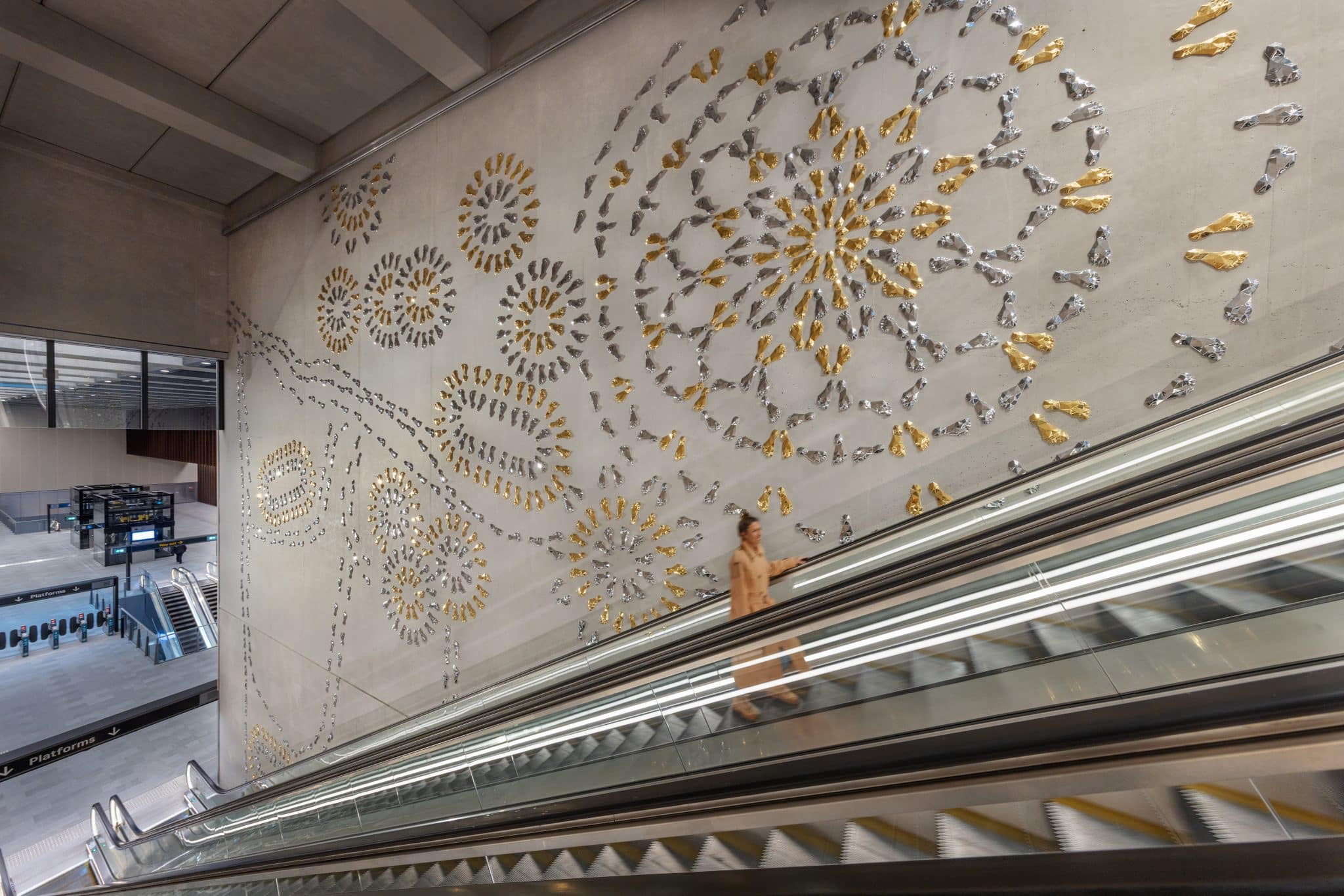
On the landing beside the escalators, more than seventy community members co-created one thousand aluminium footprints that trace culturally significant paths across the architecture.
The map underlying the work draws on City of Sydney research that records important places for Aboriginal people across time, with Waterloo now added as a living hub.
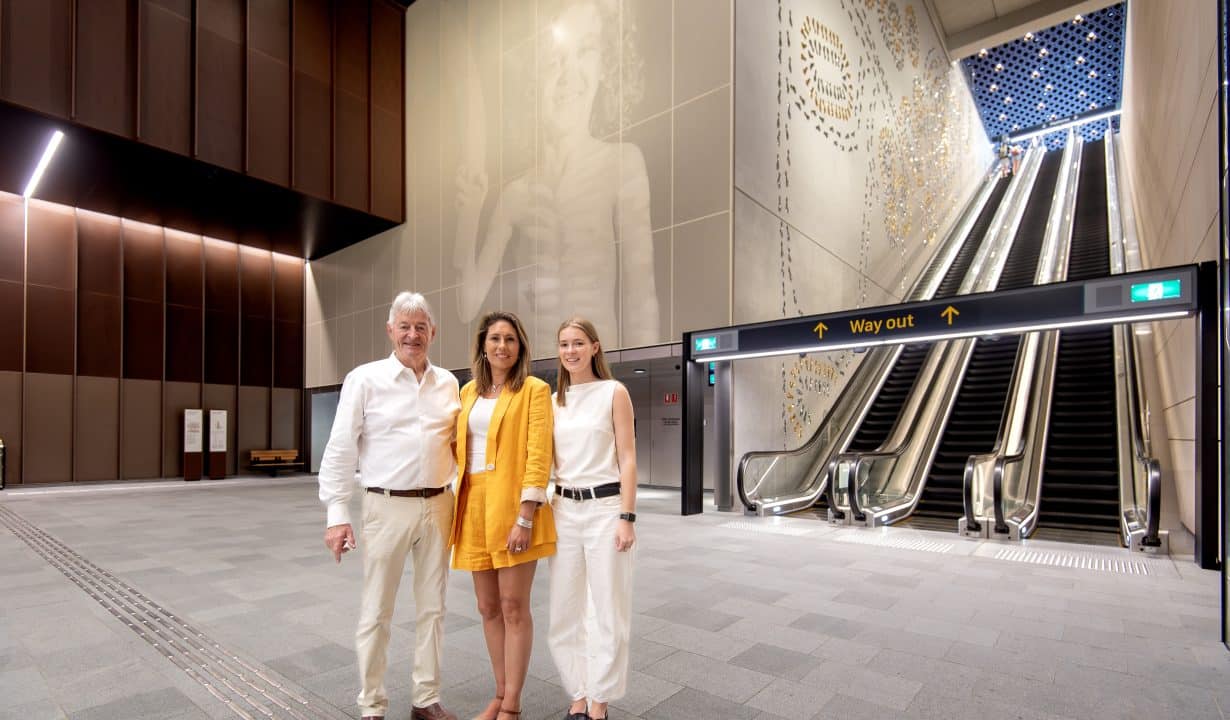
Down on the concourse, a photorealistic portrait of a local dancer, Roscoe, created with Brolga Dance Academy youth, photographer Wayne Quilliam and choreographer Jodie Choolburra-Welsh, emerges through perforated aluminium panels.
“We worked closely together to make sure we got an image that carries welcome and strength and pride in culture,” Nicole said. “
You can see him from the platform through little windows. He is up there welcoming everyone through.”

Footprints on Gadigal Nura – 2025 Indigenous Design Award + Powerhouse Design Award Winner. Image: Supplied
Making culture structural
Embedding culture into a major transport project required sustained collaboration with architects, engineers and contractors, with careful attention to standards, safety and longevity.
Doors, services and circulation had to be integrated without breaking the narrative of the work. “There are three concealed doors, including a fire door, fully integrated into the artwork,” Nicole noted, acknowledging the persistence of technical director Colin Ryan in achieving a seamless result.
Materials had to meet stringent requirements for durability, maintenance and public safety while still serving cultural intent. The dancer image went through multiple iterations before landing on a perforated metal system that carries the figure with clarity and endurance.
Across the station, the team chose metals and finishes that speak to the site, reflect light and movement and withstand daily use.
Footprints on Gadigal Nura – 2025 Indigenous Design Award + Powerhouse Design Award Winner. Image: Supplied
Building with care
Big public projects come with their own set of considerations. There are standards, safety codes, and multiple stakeholders that influence the process.
Ryan and his team championed their design intent through these realities, ensuring the vision remained front and centre through each stage of approval and delivery.
“Prototyping and testing confirmed our original manufacturing approach, with only minor adjustments. One of these was the resolution of the Roscoe image at Site C.
“Part of the reason for its success is its high-resolution, photographic quality – a detail that could have been lost without pushback from the artist team to find a better manufacturing solution,” Colin Ryan, Technical Director said.
Designing for movement, recognition and learning
The artworks do not ask for attention in the conventional way. They ask for movement, both physical and cognitive. The lenticular wall reveals language as people shift their point of view.
“It was a physical way for you to move through space to see something you might not have seen before,” Nicole explained.
Ten years ago, far fewer people would have recognised the words for Gadigal land. Today they are increasingly part of public language. The footprints pull people into a mapped story of yesterday, today and tomorrow.
The dancer carries the presence of youth and future. Together, the pieces transform a transit environment into a place of recognition and learning, where the everyday act of catching a train becomes a moment of connection to Country.
Community presence made visible
For Redfern and Waterloo, visibility is belonging.
“When aunties come with five generations to the opening, you start to understand how important these places are,” Nicole reflected.
“Roscoe was there dancing out the front. There is the kid, there is the photo, there is the dance group. We are in Redfern. It is us, and we are part of this.”
“Those are my favourite parts of the project,” Nicole said.
“Watching everybody practise culture together. Whether you are five or ninety-five, artist or not, we are all there to make a better place for First Nations people and for everybody.”
The wonderful world of public work
Large public projects demand endurance and care. They ask designers to understand traffic flow, scale, vistas and the realities of public safety. They also ask for partners who can hold the line on both quality and cultural integrity.
Nicole credits the partnership with Colin and AG Public Art for carrying the work from idea to lasting form.
“Colin and I work very closely and prototype everything so we can make sure the finishes are going to last at the level the public domain requires,” she said.
“We can go back to Community with something tangible and ask, what do you think and then refine it together. Every time we make space for that, the project gets better.”

Footprints on Gadigal Nura – 2025 Indigenous Design Award + Powerhouse Design Award Winner. Image: Supplied
The work gives back
When asked what Footprints on Gadigal Nura gave back to Country and Community, Nicole answered that it holds presence and welcomes others into understanding. But it also speaks to future wellbeing.
“All the wellbeing, all the connections of our young ones, it’s pretty bleak,” she shared.
“If we can open up these opportunities for people to connect with Country, to understand there is a real deep, long connection to this place and that we are all able to connect to it, then hopefully there’s a brighter future for people.”
This generosity extends beyond First Nations audiences. The work is not exclusive. It meets everyone who moves through the station.
“It’s important for everybody. We all live here now. If we can come to the party together, our whole world can open up in a really beautiful way.”
These words were spoken against a backdrop of increasingly visible cultural tension across the country, and they ground the project in both clarity and courage. The work does not ignore reality. It responds to it. It insists on presence, on relationship, on connection as a form of repair.
For Nicole personally, the project also affirmed possibility.
“It has shown that this is possible and we can do it well. If we are given the opportunity, Mob can change the shape of Australian design.
“Our most unique contribution begins with talking with First Nations Community and with the Country we live on, and everyone has access to that. We can elevate First Nations thinking and we can elevate Australian design together.”
She describes her role as a conduit, holding space between Community and the forces that shape the built environment, integrating cultural knowledge at a high level of design so it endures where people live their lives.

Footprints on Gadigal Nura – 2025 Indigenous Design Award + Powerhouse Design Award Winner. Image: GDA
How to build a better tomorrow
Footprints on Gadigal Nura transforms a station into a place of connection.
It tells story through form and encourages movement, both physical and emotional. It shows that public spaces can honour Country and include everyone, and that co-creation can lead to work that feels deeply human.
Most of all, it reminds us that place remembers. When design begins with respect, listening and with Community, the design itself becomes a teacher.
Good Design Australia congratulates and thanks mili mili, Nicole Monks, Colin Ryan, Elders, youth, families and collaborators, including Brolga Dance Academy, Wayne Quilliam, Jodie Choolburra-Welsh, AG Public Art, Transport for NSW and John Holland Group, for walking this work into being and for setting a benchmark for culturally responsive public design.
We recognise the Traditional Custodians of this Country and their continuing care for land, waters and community. We pay our respects to Elders past and present and acknowledge that sovereignty was never ceded.