2026 Judging Wrapped: Jury Reflections
- Published on: 30 September 2026
Share
Ahead of the 2026 Good Design Week and the much anticipated announcement of the 2026 Australian Good Design Awards, we asked some of this year’s Jury Members what it takes to be recognised in the annual Australian Good Design Awards.
This year’s theme, DESIGN THAT LEADS, asked designers to step further into the design process behind their work and own the consequences and impact of their design decisions.
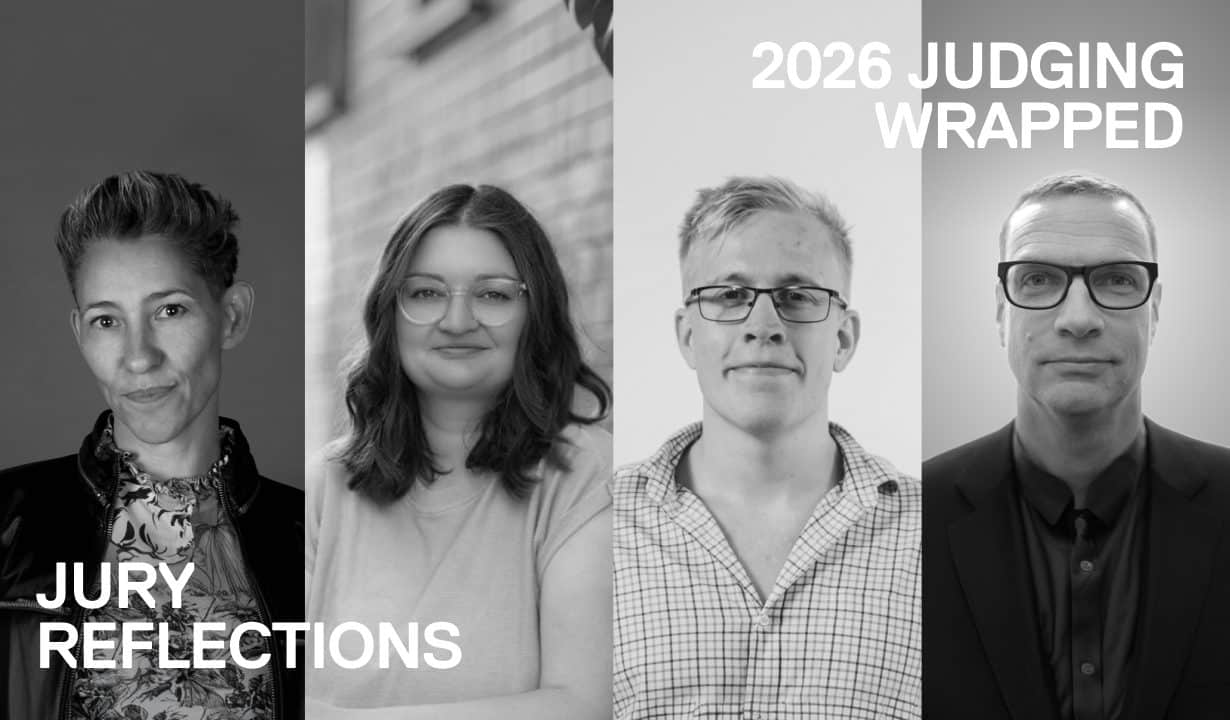
We caught up with four of this year’s jurors, Nicola Mansfield (Head of Brand, Frost*, Communication Design Juror), Sarah Lynn Rees (Associate Principal, Jackson Clements Burrows Architects, Built Environment Juror), Scott Williams (Managing Director, Xentronics, Engineering Design Juror) and James de Vries (Principal, Weft Strategy, Design Strategy Juror), to hear how judging went, what stood out, and their interpretation of this year’s Good Design Awards theme.
Can you sum up the judging process in one sentence?
Scott Williams
“The process is the perfect balance of objective judgment based on criteria, combined with organic opinions based on people’s experience and products already on the market.”
Nicola Mansfield
“The jury discussions bring a degree of rigour I wish all awards leveraged.”
James de Vries
“One of the really interesting things that’s embedding itself in the awards is the integration of better social and environmental outcomes being thought of as a prerequisite for all work.”
Sarah Lynn Rees
“There is just an incredible generosity in the way that it’s approached.”
What’s the strongest signal, or signals, from this year’s entries about where the design industry is heading?
Across the board, jurors expressed how impact is no longer a bonus, it’s the baseline.
“There is gradually an increasing level of sophistication around impact,” Mansfield said. “More designers are entering a problem and finding solutions with impact as a priority in the way they’re approaching the challenge, and that’s what design should be doing more of.”
De Vries responded, “There’s a maturing of the field and a greater sense of sophistication in design. It also makes it harder, having to consider all of that.”
Williams reflected, “The judges were looking for more sustainability, repairability, and accessibility of products. If a product wasn’t repairable or sustainable, or didn’t have an element of Circular Economy in it at all, we didn’t think it deserved anything beyond the base level award.”
For Rees, “There were definite themes in terms of care. Designing for the care of humans and the dignity of humans, designing for the care of non-humans, animals and insects and critters. Design doesn’t just serve human beings, it serves every living thing and natural system. There was a lot of rectification of the issues we’ve created as humans on the planet, and how design can solve them.”
What genuinely surprised you, stood out to you, or felt different compared to other judging processes you’ve experienced?
More than one juror flagged that they felt a strong energy of consensus this year.
“What was unusual about this year is the amount of consensus,” Mansfield provided. “From product designers, communication designers, design strategists, researchers, automotive designers, across the board. When something is a truly brilliant solution, aesthetically and for impact, it just rises above everything else.”
For de Vries, it was the structure of the process itself. “We first get to do a solo review of the work and develop a point of view on it, then we have a conversation with the other jurors in our category, and then a couple from each jury come together for a central assessment day. It’s a really good process, and it takes a lot of commitment from the judges.”
Williams was struck by the calibre in the room. “Some people in there have got twenty, thirty years of experience in the industry, which is a credit to GDA for pulling together such a strong network. You can tell it’s a mature system they’ve built over the years.”
Rees, moving into a full in-person process for the first time, was struck by what happens once every jury chair is in the same room. “Every jury assesses the projects in their own category, but then you have all of the jury chairs of every category discussing all of the top projects together, and the perspectives that provides, because of the different backgrounds and skill sets everyone in the room has, and the questions people ask, that rigour is really interesting, because everybody sees projects from a different perspective.”
The theme for this year’s Awards is ‘DESIGN THAT LEADS’, if design is really going to “lead”, what does that demand of designers next?
“Design that leads means creating something beautiful and elegant and minimalistic where it should be, maximalistic where it should be, but absolutely fit for purpose and still creating impact,” Mansfield explained. “We should never be sacrificing aesthetics for impact, nor impact for aesthetics.”
De Vries framed it as, “To lead, it needs clean thinking that isn’t just saying ‘this is best practice.’ It needs to rethink something from first principles, and combine technical adeptness with social outcome and clear communication. But design is fundamentally about doing work for others, so to lead also requires backing from the client. Building those trusted relationships is the hard part.”
Williams brought it back to process. “Design that leads has to tell a story, one that shows the thought process and the journey behind bringing that design to life. It demands you go back to the start and ask: why did we make this product in the first place? What users do we need to understand, what materials are we using, are they the latest and greatest, are they sustainable.”
Rees took the question further out. “People working in these design professions often don’t wait for policy to change to push boundaries, and I think that’s what leadership really is. What are the problems of our world that we need to solve, and how can we do them through design? If we wait for the mechanisms of government, that’s probably going to be too late. Designs that take responsibility for our environment, that solve problems for people, that give people dignity, that consider the world as a whole, that’s what leadership is. It’s pushing the boundaries that others won’t.”
What is it like being in the room on the night of the Australian Good Design Awards Ceremony – and what would you tell someone attending for the first time?
Mansfield said, “It’s the gala of galas, an evening when we can all be proud of the industry we’re working in, building toward the winner of winners and the best in class.”
De Vries is looking forward to seeing the format evolve. “What I loved last year was seeing designers get the chance to really talk and connect. I know Brandon, Rach and the GDA team are changing it up this year, giving even more room for that.”
This will be Williams’ first ceremony on the other side of the table, having entered and won as a designer in previous years. “It’ll be very satisfying seeing the results of two full days of judging, and seeing people’s faces light up when they’ve received their award. I think it’ll make me even more grateful and reflective of what it took for us to make it that far ourselves.”
Rees hasn’t yet locked in her calendar for this year’s ceremony, but she leaves the process with a note on what held it together. “The respect of the process, held by each of the judges in the room, to be able to have those conversations even when there are moments of disagreement, that in itself is worth noting. It’s quite beautiful, really.”
Across all design disciplines, the same word kept coming up: rigour. There was a genuine respect for the process, and for each other, carried through every conversation.
We thank all the jurors for their hard work throughout this year’s judging process. We’re looking forward to announcing the 2026 winners during the 2026 Good Design Week from 5-9 October.