The First Building, Bradfield City Centre – 2025 Good Design Award for Sustainability
- Published on: 22 October 2025
Share
THE GOOD DESIGN AWARD FOR SUSTAINABILITY RECOGNISES PROJECTS THAT EMBODY EXCELLENCE IN DESIGN FOR SUSTAINABILITY AND CIRCULAR ECONOMY PRINCIPLES.
THE AWARD AIMS TO INSPIRE CHANGE TOWARDS A MORE SUSTAINABLE FUTURE.
Imagine a building where people, Country, and the planet don’t just influence design, they shape every detail. First Building brings that vision to life. Winner of the 2025 Australian Good Design Award for Sustainability, this state-of-the-art manufacturing facility in Australia’s newest city redefines urban design, showing what’s possible when human and environmental priorities converge.
Rising in Bradfield City Centre, it acts as a catalyst for sustainable growth and innovation, with circularity, adaptability, and resilience woven into its very structure. Led by the Bradfield Development Authority (BDA) and NSW Public Works, and designed by Hassell in collaboration with cultural research agency Djinjama, the building seamlessly integrates regenerative design, cultural storytelling, and cutting-edge technology.
Liz Westgarth, Managing Director and Architect at Hassell, takes us inside the thinking behind the design.
A benchmark for place-based, regenerative architecture
First Building is Stage 1 of the Advanced Manufacturing Readiness Facility (AMRF), where government, industry, and researchers collaborate to drive innovation and support businesses, anchoring the emerging Aerotropolis set to transform Western Sydney.
“It needs to not only set the tone for the new city, but also act as a catalyst for bringing high-value manufacturing jobs back into New South Wales. That responsibility shapes the urban fabric that follows,” Liz Westgarth said.
The goal was clear: create a space that inspires industry, community, and sustainability in equal measure.
“For us, it was about how buildings can positively contribute to the urban environment, demonstrate Circular Economy principles, and honour Country. We focused on innovation and sustainability, pushing boundaries while remaining grounded in place,” added Liz.
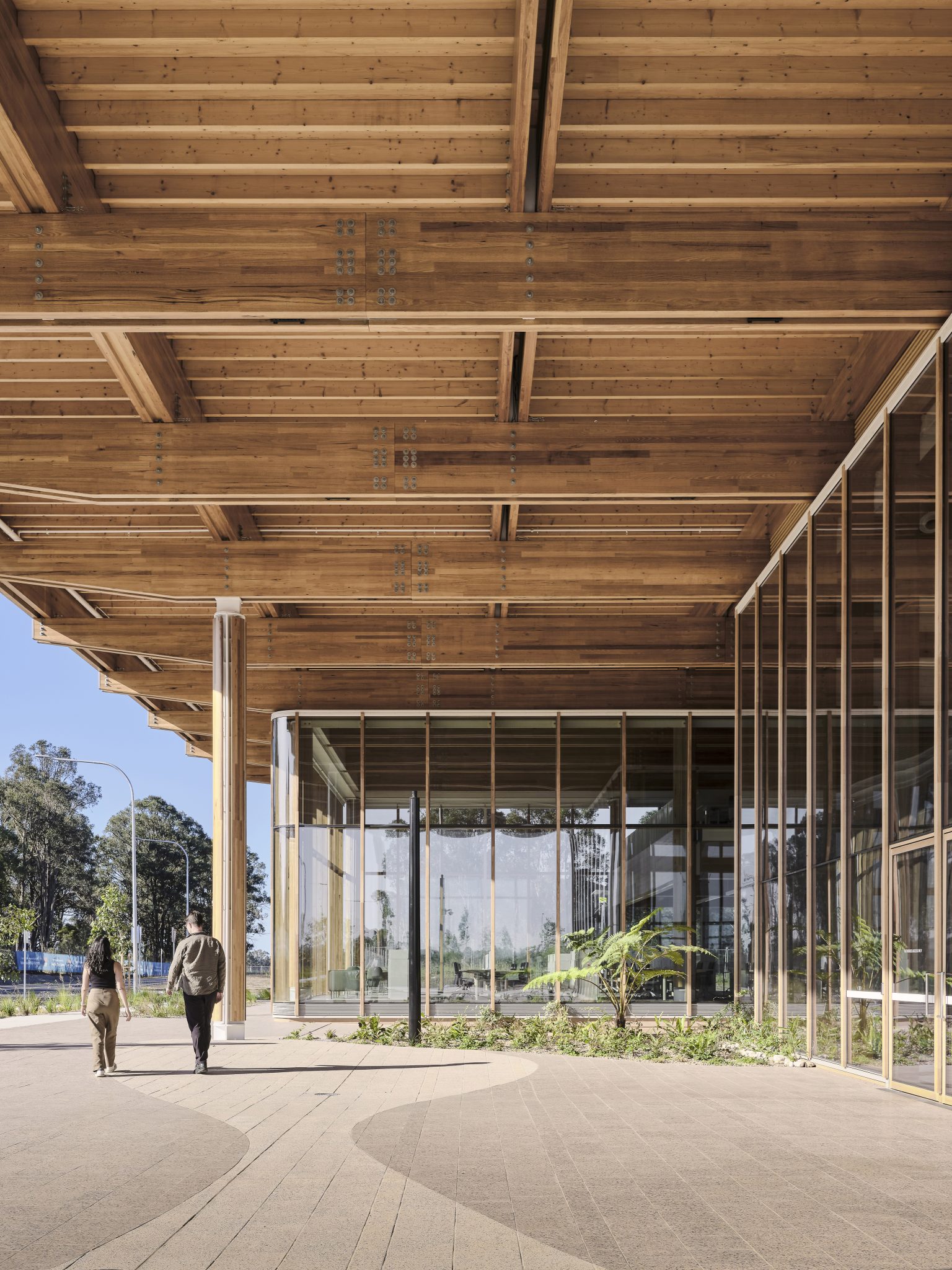
The First Building – Bradfield City Centre – Winner of the 2025 Australian Good Design Award for Sustainability. Image Credit: Mark Syke
Circular design at the core
Breaking from the traditional take-make-dispose model, the project puts reusing, recycling, and adaptability at the heart of its design.
“What we wanted to do was design a building that could adapt to a different use. The building is a modular kit of parts. It can be completely disassembled, re-erected somewhere else in the city, or recycled for a completely different use,” said Liz.
“If we could design more buildings that could adapt and change, that would be more sustainable. Construction and demolition generate 40 per cent of waste, so designing for reuse makes a positive contribution to our planet,” she added.
Materials that tell a story
The site, known in the local Dharug language as Wianamatta (‘Mother Place’), holds deep significance for First Nations women. Guided by Djinjama, the design is deeply embedded in Dharug Country, reflected in the building’s open, welcoming expression, fluid design language centred on water, and the use of warm, soft, natural materials such as timber, bamboo, and rammed earth.
“We chose materials with low embodied carbon, quite natural, but also with a warmth that reflects Country. There’s extensive use of timber in the structure. Around the core, we have rammed earth, which directly relates to and reflects Country, along with bamboo and other sustainable, renewable materials,” Liz explained.
The project, targeting a 6 Star Green Star Buildings rating, challenges supply chains and advocates for natural, low-embodied carbon materials.
“Even in the bathrooms, we use tiles made from recycled textiles through a collaboration with UNSW Microfactory. From the structure down to the bathroom tiles, every material is carefully thought through – not just for sustainability, but for how it tells the narratives of Country,” Liz added.
“Innovations in timber construction systems, modular design, and low-impact materials all form part of the regenerative design concept. Through its materials, the building conveys warmth and softness, with curves that give it a feminine quality and a sense of welcome. Much like our own mothers, it has that comforting presence while also reflecting the water story,” she explained.

The First Building – Bradfield City Centre – Winner of the 2025 Australian Good Design Award for Sustainability. Image Credit: Vinchy Wu
A city that breathes
First Building raises the bar for sustainable architecture with a clever natural ventilation system that slashes energy use. For roughly 60% of the year, atrium and façade panels cool the building naturally, while chimney stacks sweep out hot air on summer nights, reducing reliance on mechanical systems.
The manufacturing hall is equally impressive. A custom airport-style door blends seamlessly into the façade, supported by sleek structural steel framing that balances practicality with a clean, modern look.
Crowning the building, a green roof planted with 14,000 native species harvests water and solar energy, provides shade that cools the roof by up to 20°C, and enhances biodiversity.
“The landscape takes cues from the historic Cumberland Plain, with tall stands of eucalypts reflected in the verticality of the building, while increasing biodiversity on site,” said Liz.
“We’ve planted about 14,000 different plants on the roof, which has brought back all sorts of creatures, including five to seven species of dragonflies.”
Mirroring the surrounding tree canopies, the roof anchors the building to its natural context and complements a broader ecological strategy: captured rainwater irrigates the landscape, biodiversity is restored, and the site’s ecological identity is strengthened.
Combined with passive cooling and solar-plus-battery systems, The First Building cuts life-cycle impacts by 32%, operates net-positive, and sets a precedent for regenerative urban design in the emerging Aerotropolis.

The First Building – Bradfield City Centre – Winner of the 2025 Australian Good Design Award for Sustainability. Image Credit: Vinchy Wu
Building opportunity into the city
Shaping not just the city’s landscape but also opportunities for people and communities, First Building showcases the real-time progress of Australia’s newest sustainable, connected city.
“It is all about being a catalyst for high-value manufacturing jobs in New South Wales. Australia has lost much of its manufacturing ability, so this is about bringing that back,” Liz said.
The facility supports smaller businesses and startups, giving them space to grow and innovate. Comprising two pavilions – a 1,000m² manufacturing hall and 2,500m² workspaces – connected by a central spine, the building’s transparent facades invite public engagement while echoing the tree stands of the Cumberland Plain.
“We intentionally made the manufacturing hall transparent so visitors can see processes on show and understand the work,” Liz said.
Even design challenges became opportunities. Built before Bradfield’s Master Plan was finalised, the project acted as a test case, with its street-edge siting ensuring the building feels active and integrated as the city grows.
“Moving it to the perimeter near the footpath was crucial. It doesn’t feel like a business park and allows key master plan principles to come to life,” Liz explained.

The First Building – Bradfield City Centre – Winner of the 2025 Australian Good Design Award for Sustainability. Image Credit: Mark Skye
Bold ideas backed by thoughtful execution
Challenging conventions and embracing possibility, The First Building turns innovative ideas into a tangible legacy of sustainability and place-based design.
“Be brave enough to put some big ideas on the table. That’s one of the big lessons and learnings for me on this project,” Liz reflected.
“You can come up with all these great ideas, but then you’ve got to execute them down to the details. It takes rigour and tenacity,” she added.
The building explores bold approaches such as disassembly and timber use in an industrial facility, prioritising Circular Economy principles and low-embodied carbon materials. Its modular timber structure can be disassembled, reused, and adapted, cutting future waste.
Over half the timber is locally sourced, and advanced timber technology slashes embodied carbon by 50%, removing the need for concrete. Life Cycle Assessment shows a 25% cut in upfront carbon and a 32% drop in total life-cycle impact. Operational energy is 137% offset by a 180kW rooftop solar array and 460kWh battery, making the building net-positive.
These strategies demonstrate how good design principles can leave a lasting legacy.
“Good design, to me, means leaving a positive legacy, both for people and the planet. It has to resonate with both. For me, The First Building showcases culture and context, and pushes boundaries in sustainability and regenerative design,” Liz added.
“Ultimately, it’s about making people think differently about buildings and design, and hopefully sparking ideas for others to push their own projects to the next level. I feel really humbled when people visit and say, ‘I just couldn’t believe that…’ There are so many great stories and narratives, it’s sustainable, and it just feels incredible to be in these spaces,” Liz explained.

The First Building – Bradfield City Centre – Winner of the 2025 Australian Good Design Award for Sustainability. Image Credit: Mark Skye
The First Building doesn’t just rise from the Cumberland Plain – it grows with it. Designed to evolve with the city, the building has already generated 200 jobs and channeled over $12 million into local businesses, including First Nations businesses, while opening its doors to the community.
Its modular design adapts as Bradfield City grows, proving that flexibility and resilience can be built in from day one. Now recognised with the Good Design Award for Sustainability, The First Building sets a new benchmark for how cities can be regenerative and integrate with Country.
Good Design Australia congratulates and thanks this multi-disciplinary team for pushing the boundaries of design in the built environment, and redefining city-building in Australia.