Bushfire Social Intelligence – 2023 Michael Bryce Patron’s Award

THIS AWARD IS PRESENTED ANNUALLY BY THE PATRON OF GOOD DESIGN AUSTRALIA. IT RECOGNISES AND CELEBRATES THE BEST AUSTRALIAN-DESIGNED PRODUCT, SERVICE OR PROJECT IN THE ANNUAL AUSTRALIAN GOOD DESIGN AWARDS WITH THE POTENTIAL TO SHAPE THE FUTURE ECONOMIC, SOCIAL, CULTURAL AND ENVIRONMENTAL ASPECTS OF OUR PLANET.

In the summer of 2019-2020, an estimated 16 million hectares of land burned across a drought-stricken Australia. Aptly coined the Black Summer, hundreds of blazes ravaged ecosystems, communities and infrastructure for almost twelve months, taking the lives of over 30 people, killing or displacing up to 3 billion animals and causing around $200 billion in damages.

In this catastrophic summer, more individuals than ever before forgoed the traditional “000” route to instead take to social media to share bushfire updates, stay connected and cry for help. It saw emergency services needing to quickly adapt to a new online norm, sifting through status updates and photo uploads to piece together bushfire trajectories and strategise their next moves. 

The people, processes and existing technologies of Australia’s fire services were pushed well beyond their limits as smoke suffocated the country. So, in the wake of a scorched continent and a radical shift in the way individuals report bushfires, Abby Phillips – Senior Product Designer at Kablamo – and her team sought to prevent such a catastrophic event from ever happening again.

The result is Bushfire Social Intelligence, a world-first emergency services workflow providing highly relevant public information to firefighters. The machine-learning (ML) and artificial intelligence (AI)-optimised innovation assists in early fire detection, fire behaviour analysis and response time enhancement. Bushfire Social Intelligence has also been named the 2023 Michael Bryce Patron’s Award recipient. 

Good Design Australia caught up with Abby Phillips and Dee Behan – Managing Director and Design Principal at Kablamo Design Studio – to dive deep into the transformation project, its potential and the importance of human-centred design. 

Bushfire Social Intelligence – 2023 Michael Bryce Patron’s Award


Good Design Australia: Australia is a continent known for the bushfire, with many fire-led catastrophes dotting its history. How would the Bushfire Social Intelligence platform come into play in the time of a fire?

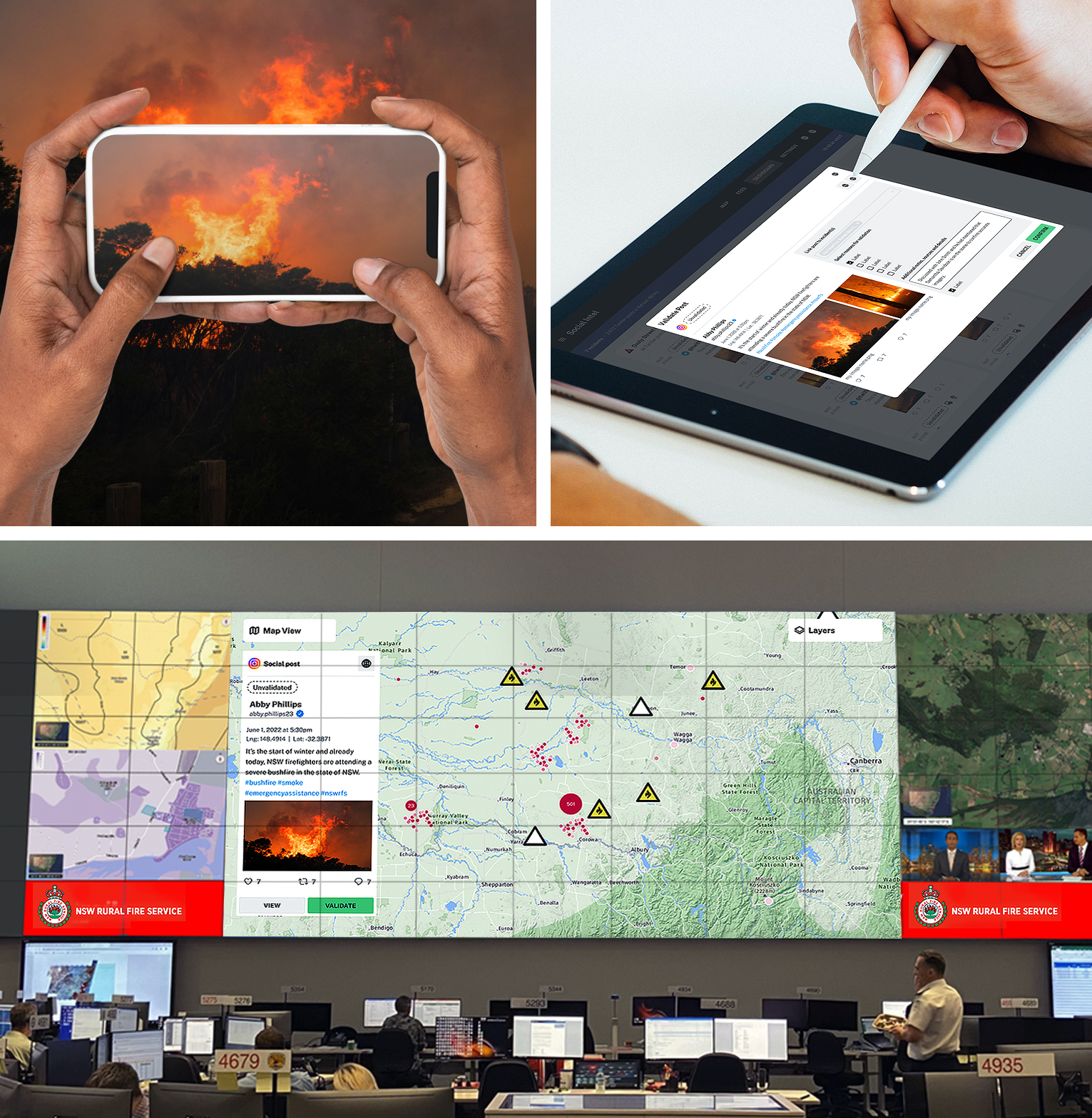
Abby Phillips: Bushfire Social Intelligence includes a suite of features integrated within Athena – a platform that we’ve been developing with the New South Wales Rural Fire Service for nearly two years now. Using a ML model trained on keywords and hashtags that are relevant to bushfires or emergency services, it collects and visualises vital information. It also uses imagery recognition, looking at imagery on social media that has fire, smoke and other landmarks.

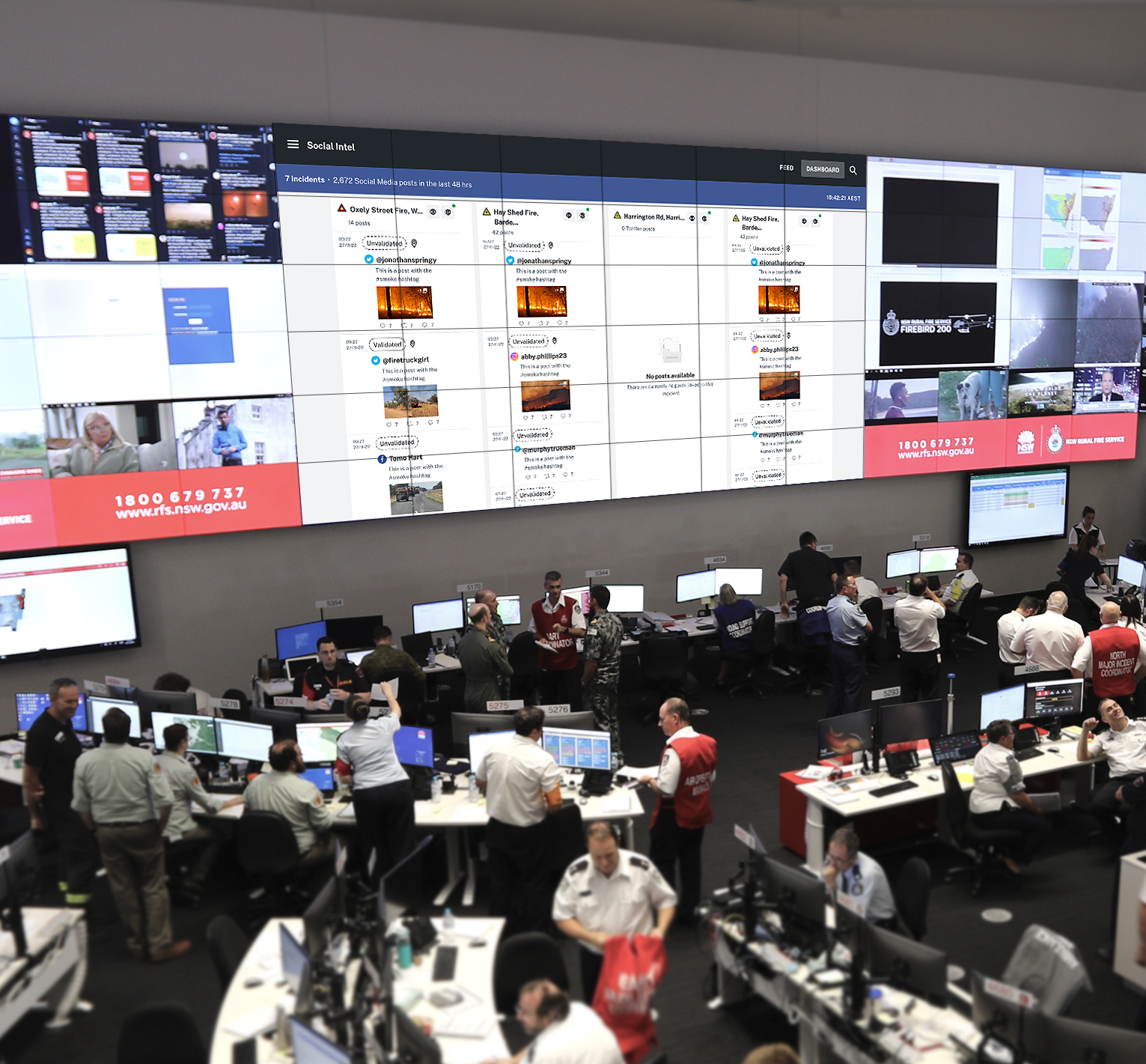
All relevant information can be plotted on a map within Athena which can show its relationship to known incidents, whether it’s near a known fire or a hotspot, or even infer that there is an ignition we didn’t know about. Emergency services all have teams that sit at computers and trawl through Facebook, Twitter and Instagram looking for those posts, so Bushfire Social Intelligence speeds up the process to detect or slow down fires before they get out of control.

GDA: It seems a lot of raw data, keywords and photos are collected in the social media scanning process. How can the platform tell what is relevant and what is not? 

AP: That’s the machine learning part, where there are always challenges to overcome. A lot of computer vision models that already existed were based on the US context, so we had to spend time training the AI model in the Australian context with the Australian environment, and we still have more work to do in this space. With the keywords and hashtags, something that became obvious in the design process was there are a lot of keywords that trend due to different societal issues at a point in time that do not contribute to bushfire management. This means it’s not as simple as pulling a bunch of data from Twitter, for example, that was trending at the time and putting it into a machine learning model. 

So it was a lot of trial and error to optimise that, a lot of workshops, a lot of sitting down with users and people that had been managing social media data throughout recent bushfire seasons and understanding to them, what they considered to be data that is used as intelligence and not just general information generated from the community.

Bushfire Social Intelligence – 2023 Michael Bryce Patron’s Award

GDA: Would you describe this as more of a human-led approach to a ML and AI-optimised solution? Why is this important?

AP: Yes, for sure. I think if you’re starting with the technology and the solution first, then you’re not considering the problem you’re actually solving for. For machine learning in particular, I believe it only works if you’re starting with a problem in mind. That human-centred design mindset and the design-thinking approach really helps you uncover the problems you’re going to solve, who they are for and whether or not we can solve them with these people. Not for them or at them, but bringing them on the design journey.

For the Bushfire Social Intelligence project, the problem we were primarily looking to solve is the massive amount of time emergency service personnel were taking to sift through all of this information, and then the time it takes the information to get to the people that need it to make those really critical decisions. Once we had defined that, we could understand that machine learning was one of the right solutions to apply to this problem. 

GDA: Talking scalability, can the Bushfire Social Intelligence technology be applied to other natural disasters for example? How can it keep up with the speed of social media?

AP: It can be applied to any natural disaster, as long as we’re working alongside people that are experts in those emergencies and understand what they’re looking for. After all, we’re not firefighters, right? We’re technology and design experts. So, we have to be designing with those people that have got the knowledge. We have a great baseline for what machine learning and object recognition models can do – it just needs the relevant data.

Talking about social media, we’ve actually designed the user interface and the technical architecture so that it can integrate with future social media or crowdsourcing platforms. This sees repeatable design patterns and content containers flex to allow data from any social media platform be used. It means we don’t need to spend time redesigning an interface to visualise information from new sources, and can focus instead on other high impact initiatives.

GDA: Zooming out a bit, how would you describe design’s general potential to face or challenge big societal or environmental issues? In what ways can it ignite positive change within communities?

AP: I think that, as designers, we know how to ask the right questions. We’re really good at being strategic thinkers and thinking of the problem holistically. We can partner with the users, and the technology experts – we’re really the people that are able to join the dots between the whole picture. Design can create an interconnected, innovative environment that allows innovative technologies to be applied to the problems we’re solving.

Dee Behan: Just to add to that; with any sort of societal change or environmental change, there’s always those systemic barriers or legacy systems that we have to overcome. Without a design-thinking mindset, it’s very difficult to just inject a new way of working or expect a new tech to actually be adopted.

As Abby was saying, it’s going right back to all that interconnectedness. Designers can really map together and understand how a positive change can happen. It works. Just looking at the [Bushfire Social Intelligence project], the work that the team is doing is ultimately saving lives, saving our environment, it’s saving animals. It’s actually the most crucial work. I think the vision at its core is that “we will be saving lives”. That is at the forefront of everybody’s mind.


VIEW ALL 2023 GOOD DESIGN AWARD WINNERS HERE
Solid Lines – 2023 Indigenous Design Award

2023 Indigenous Design Award Winners – Solid Lines Design Team

PROUDLY PRESENTED BY RMIT UNIVERSITY, THE INDIGENOUS DESIGN AWARD RECOGNISES AND CELEBRATES THE IMPORTANT CONTRIBUTION THAT AUSTRALIA’S ABORIGINAL AND TORRES STRAIT ISLANDER DESIGNERS MAKE ACROSS THE SPECTRUM OF AUSTRALIAN DESIGN.

THE AWARD WELCOMES NOMINATIONS OF INDIGENOUS INDIVIDUALS AS WELL AS PROJECTS WHERE AT LEAST ONE MEMBER OF THE DESIGN TEAM IDENTIFIES AS ABORIGINAL OR TORRES STRAIT ISLANDER. RMIT AND INDIGENOUS COMMUNITY REPRESENTATIVES EVALUATE NOMINATED SUBMISSIONS AND SELECT THE OVERALL WINNER FOR THE AWARD BASED ON SPECIFIC EVALUATION CRITERIA.

Solid Lines is all about creating solid pathways for emerging First Nations artists to find success, recognition, support and fair representation within the art and design industries. As Australia’s first First Nations-led illustration agency, it’s reimagining the future commerciality of Indigenous and Torres Strait Islander creativity, contributing to policy development and setting new standards within Australia’s creative space along the way.

However, as head designers Emrhan Tjapanangka Sultan and Dr Nicola St John tell Good Design Australia, they aren’t pathways easily forged. The art and design industries are often ignorant of First Nations ways of working, and there are few existing platforms that represent First Nations creatives on their own terms, in culturally safe and supported ways.

Solid Lines agency therefore innovates at a much-needed crossroads of policy, opportunity and design, representing the first phase of a long journey that champions the protection of Indigenous Cultural and Intellectual Property (ICIP). It involves the curation of beneficial partnerships and culturally safe creative opportunities that respect and give back to community.

Good Design Australia sat down with Emrhan and Nicola ahead of the announcement of Solid Lines as the 2023 recipient of the Indigenous Design Award. 


Good Design Australia: Before we dive into where Solid Lines is now, let’s jump backwards a bit to define the challenge it faces head-on.

Dr Nicola St John: The idea and the concept of Solid Lines really came from conversations Emrhan and I had around the lack of representation and access for First Nations creatives in these more commercially oriented, design-based industries. There weren’t these safe and supportive pathways to support First Nations artists to gain access to such spaces. What do you reckon Em?

Emrhan Tjapanangka Sultan: The artists that we spoke to at the very beginning stages of the artist consultation process felt like they weren’t being represented culturally, specifically around intellectual property. We found that a lot of agencies owned the rights to a lot of the artworks that were being designed by these artists. So, we wanted to make sure that what we set up with Solid Lines supported artists to own their own works. 

GDA: To ensure artists always had something to hang their hat on?

NSJ: Yes. When you think of Western or Eurocentric licensing practices, artwork licences or brand copyright for example, it’s quite different to how First Nations artists and communities would like to do it. So Solid Lines was really built around developing a licensing policy that protected First Nations artists and their cultural heritage.

We worked with a First Nations lawyer to develop the ICIP. It helps protect First Nations artists when clients are licensing First Nations work or working with First Nations artists, and it ensures that clients aren’t inadvertently stealing First Nations art or knowledge or culture, or trying to copyright things that can’t be owned, in a commercial sense.

2023 Indigenous Design Award Winner – Solid Lines

GDA: Solid Lines is evolving through somewhat of a phase-by-phase journey. Where are we now, and where is it headed?

ETS: We’re in stage one at the moment – the nesting period. We just celebrated our first anniversary, actually, and are looking at going into phase two pretty soon which will continue to establish Solid Lines as a standalone First Nations-owned business.

GDA: The last phase sees Solid Lines become a First Nations owned, operated and controlled business, but giving back to community is another integral part of the business structure. How will this work?

NSJ: Giving back to community and having a community at the heart of everything that we do at Solid Lines was something that came out of our collaborative approach to developing the agency directly alongside artists. All the artists are really keen to invest back into community and provide access and representation for the next generation of artists coming through as well. 

So a percentage of all of the profits go back into our Community Development Fund. It’ll allow us to develop programmes that  reinvest back into communities where the artists are from, but also other communities around Australia  where First Nation creatives might not have access to digital design skills or design education or pathways into these commercial industries. So we’re really excited to be able to start that next phase of the business.

ETS: We also want the agency to be really transparent with the artists, which is why it was really important for us to have those conversations with the artists to find out from them what was fair. We’ve heard too many stories of artists feeling like they were being ripped off by agencies within the industry, so being really transparent around where the funds are going and how they’ve been spent is important.

GDA: There’s a phenomenal quote from artist Coree Thorpe on the Solid Lines website. It notes: “Aboriginal art is always evolving and we’re evolving as well. We don’t want to be pigeonholed as Aboriginal artists, but be acknowledged as contemporary artists in our own right”. Is this transformational shift something that Solid Lines is pining for?

ETS: Absolutely. I think when we’re looking at protecting our artistic culture, you see a lot of fake art coming in from overseas. A lot of people also, when they think about Aboriginal art, think of the traditional style dot paintings or the top end style artwork that’s become really popular. We really wanted to kind of encourage understanding that there’s more to the Aboriginal art space. We have Aboriginal artists in different graphic design industries, visual artists, muralists – we wanted to expand on that as well.

Something that I’m really passionate about as well is opening up pathways for, and working with, younger artists who may not have grown up deeply connected to their culture. They’re still on a journey and inventing themselves as artists. With a bi of guidance they’re able to learn a bit more about their culture and the types of art styles that belong to their people.

NSJ: Solid Lines is really trying to change the face of Australia’s design industry. And for me, I think design is a powerful way to represent national identity and stories as an industry. So Solid Lines is kind of really shifting that narrative. It’s shifting the story of what Australian design is, what it represents, what its values are. Also, I guess, what it can look like. It’s all about creating a much more diverse and representative agency of what Australian design actually is that draws on all that rich heritage and knowledge of our first peoples.

2023 Indigenous Design Award Winner – Solid Lines

GDA: To get very meta, knowing that Good Design Australia defines “good design” as ideas, products, services, that show potential to lead a better, safer and more prosperous future for all, how would you both describe “good design” yourselves?

NSJ: That is a hard question. I think maybe “good design” is something that tells an important story and offers an accurate representation of culture, or enables one to express themselves and their cultural heritage. Good design supports culture.
ETS: And that extends to the world stage as well. Something that I would like to see in other countries is the blueprint of Solid Lines being established for other First Nations or Indigenous peoples so their cultures can be protected as well. For example, you see throughout the US and Canadian markets a lot of Native American style artworks being manipulated. So, I’d like to see good design and the Solid Lines blueprint supporting culture around the world.


VIEW ALL 2023 GOOD DESIGN AWARD WINNERS HERE