CREATIVITY TO BE REVITALISED ACROSS AUSTRALIAN INDUSTRY
The Australian Design Council, a not-for-profit industry body dedicated to driving national prosperity and long-term growth through design, is thrilled to announce a significant boost to its mission with a generous $1 million donation from Peter Freedman AM, Founder and Chairman of RØDE, one of the world’s leading creator technology brands.
The Australian Design Council has a rich history dating back to the 1950s when it was originally known as the Industrial Design Council of Australia. However, it ceased operations in the mid-1980s. In 2020, design leaders Dr Sam Bucolo and Dr Brandon Gien rallied Australia’s “Captains of Industry and Design” to explore the possibility of relaunching the Council. Recognising the critical role that world-class design talent plays in Australia’s innovation landscape, that effort has now led to the re-establishment of the Australian Design Council as a not-for-profit company.
Peter Freedman’s generous $1 million donation will be instrumental in jumpstarting the Council’s activities. These funds will be distributed over two years and will enable the organization to employ a CEO and essential staff while also attracting additional sponsorship and revenue. Peter Freedman will be recognised as the Australian Design Council’s Founding Patron.
Mr Freedman’s commitment to advancing design and manufacturing in Australia is well-documented. He has been a dedicated supporter of the Good Design Awards, serving as the principal sponsor of the Next Gen category for nearly a decade, and has contributed hundreds of thousands of dollars to support emerging designers and innovators. He is also an avid supporter of Australia’s creative sector. In 2021 he donated $5 million to the Sydney Festival and this year made a significant contribution to the Australian Chamber Orchestra.
Expressing his enthusiasm for this initiative, Peter Freedman said, “Design is not just about aesthetics; it’s a critical driver of innovation and economic growth. I am honoured to support the revival of the Australian Design Council and look forward to seeing the positive impact it will have on our nation’s future.”
Dr Sam Bucolo, one of the leaders behind the Council’s revival, said, “The overwhelming support from Government, the Research community, and the Business sector underscores the vital role the Australian Design Council will play in shaping our nation’s innovation landscape. We are deeply grateful to Peter Freedman for his generous donation, which will accelerate our mission to advocate for a design-led future for Australia and champion the next generation of designers.”
The Australian Design Council has also announced the appointment of a board of non-executive directors who will collaborate with current Council members to fulfill its mission. The board includes distinguished individuals such as Ros Moriarty, Catherine Livingstone, and Peter Freedman as directors of the company. Sam Bucolo and Brandon Gien will continue in their roles as executive directors.
The Council is determined to build upon its rich legacy and reestablish itself as a cornerstone of Australia’s innovation ecosystem. Its commitment to excellence is further demonstrated by its continued collaboration with Good Design Australia to promote and celebrate outstanding design work in the country.
THE GOOD DESIGN AWARD OF YEAR IS AWARDED TO ONLY ONE EXEMPLARY PROJECT ACROSS ALL DESIGN DISCIPLINES AND CATEGORIES.
Agricultural growers traditionally rely on their own intuition and symptomatic indicators to manage crop disease. While the incredible knowledge and experience of the world’s growers cannot be understated, these orthodox approaches can sometimes leave room for ailments to take hold unknowingly, or misguide overseers down damaging avenues of management and overspraying.
In the face of an increasingly organic world, growing agricultural costs and a greater understanding of the possible adverse effects of disease eradication measures, the BioScout team recognised an opportunity for a revolutionary technology to fill in the blanks. The result was a world-first airborne disease tracking device that equips growers and agronomists with autonomous insights into a crop’s microclimate.
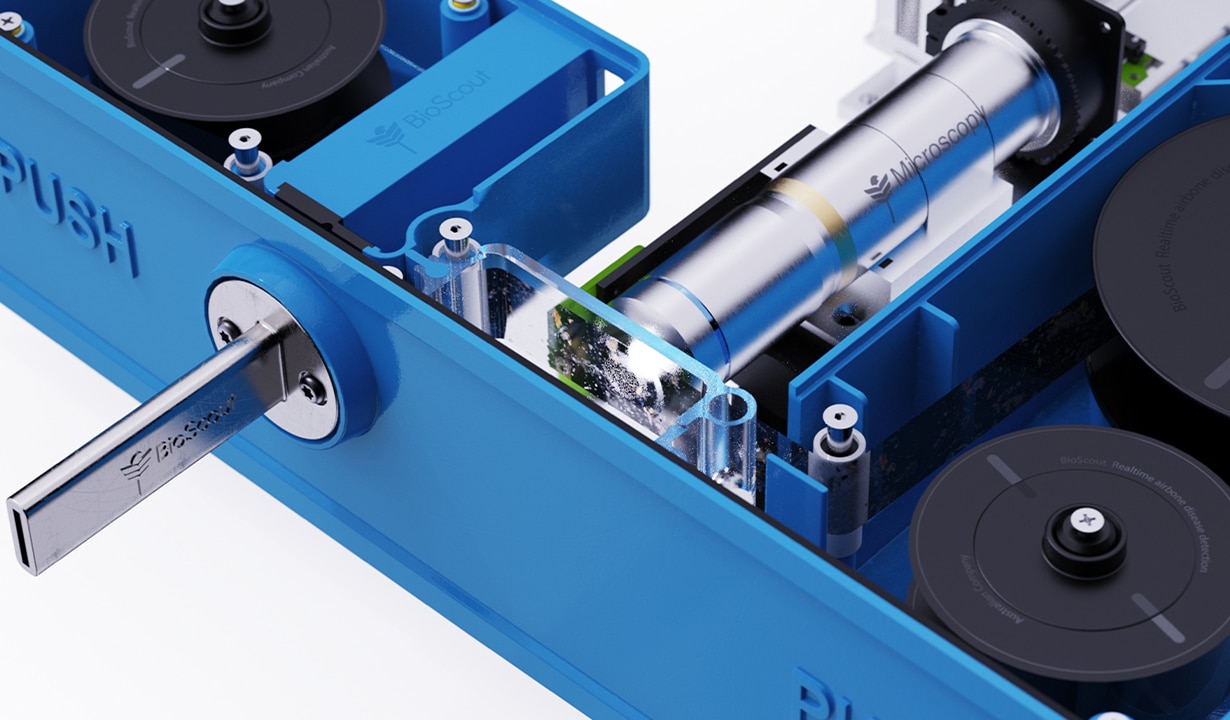
The BioScout system is a self-sustaining, solar-powered unit that sits harmoniously in fields and vineyards. Using an in-built spore sampler and an array of sensors, it captures airborne particles in real-time, collecting location and disease-specific data that is uploaded to a cloud-based server. Machine learning algorithms are then applied to identify and classify spores at speed before notifying farmers and allowing for immediate action.
BioScout sees the unseeable in a range of complex agricultural settings and can function continuously for years without human intervention. By detecting issues early on, it empowers growers to rely less on chemical spraying and promotes healthier, higher-yield crops. Already, the device has seen incredible success out in the field, affording farmers and viticulturists a means to take the guessing game out of their disease control measures. Bioscout has also earned itself the prestigious Australian Good Design Award of the Year for 2023.
Good Design Australia went back and forth with Lisa Gyecsek and Robert Tiller of Tiller Design, who collaborated closely with the BioScout Team, to dive deeper into the incredible innovation.
Good Design Australia: It’s commonly said that the agricultural space is rooted in tradition, so how would describe the role design, and specifically technological design, plays within the industry?
Lisa Gyecsek: I think there actually is a lot of technology out there. The universities are producing amazing inventions and having amazing success with a lot of the theories and findings. The big challenge really in the industry, is making that leap into commercialisation and making it into a product that is useful for the masses. That’s where it comes unstuck, and I believe that’s because it’s a journey that’s not familiar to a lot of people.
BioScout is a perfect example of people coming together with a great idea, passion and the industry smarts, to coordinate it well and make a difference.
GDA: BioScout aims to see the “unseeable” diseases in a crop. How exactly does it target and detect these ailments?
LG: It catches and identifies a range of spores and algae. It uses a carefully regulated airflow intake to draw in the surrounding air, across an adhesive film, to trap and collect airborne pathogens, pollens and particles. It’s like putting a roll of sticky tape out into the wind and collecting what’s there. It knows all the environmental conditions around its capture and the exact timestamp of when it was caught, and then uses high definition, microscopic photographic imagery to zoom in and identify what it finds.
The collected data is securely sent to the cloud and into a live database where information surrounding any detected spores or disease is sent out as an alert to a farmer, or whoever’s interfacing with it. They will immediately know, in real-time, what’s happening out there in the crop environment.
GDA: How did the design journey begin?
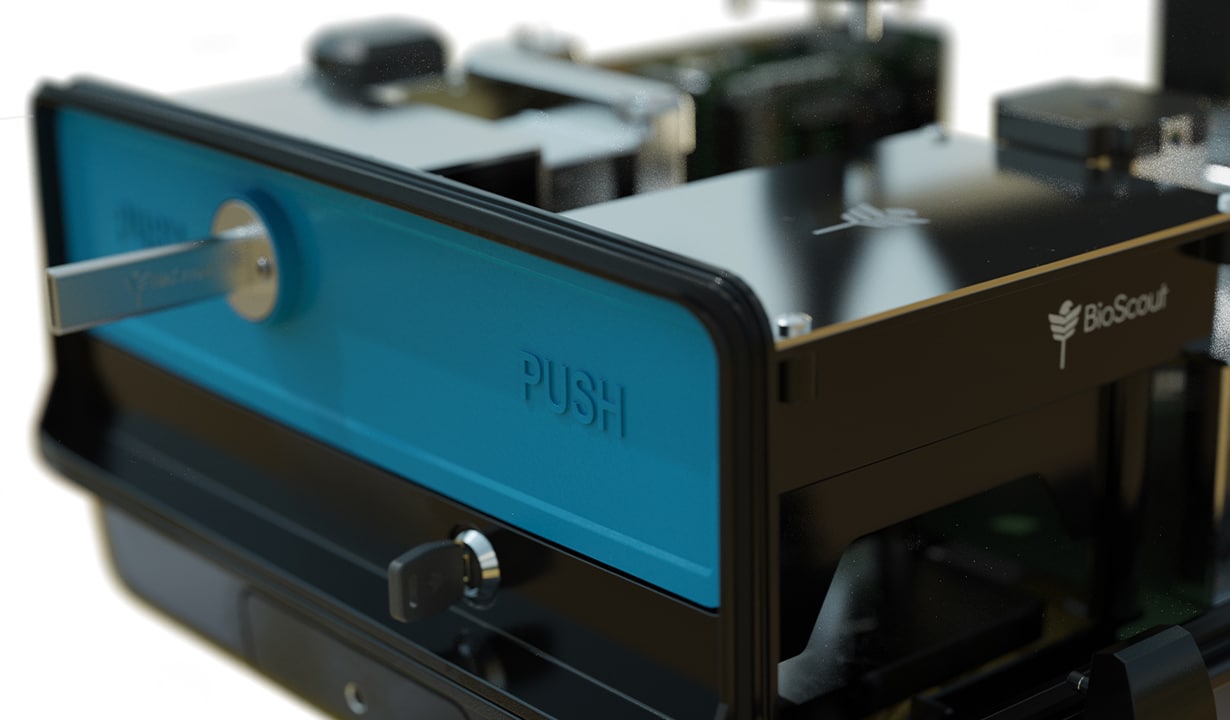
LG: Tiller Design was engaged by BioScout, and they basically had a proof of concept that we took apart and redesigned in order for it to be a commercial product. That meant re-engineering the product, which we did in 3D CAD, and assembling it all so that each part is reproducible on a manufacturing scale. So, injection moulding, die casting, fabricating any jigs and fixtures that needed to go together, making sure that the assembly held and optimising the critical architecture of the internal fans and the cameras. We also ensured the right material was selected so it didn’t disintegrate under UV light and that the housing was able to hold larger capacity batteries.
One of the main features that the BioScout team asked us to incorporate was a spore-collecting cassette tape that was user friendly. We needed to ensure it didn’t require the hand of any highly-skilled technicians to go out and change it, and that anyone could swap cassettes in and out without breaching any of its structural integrity. Before we were engaged, the cassette was non-existent.
GDA: BioScout seemingly offers a transformational solution within the agricultural space. How would you describe design’s potential to revolutionise industry, especially in the face of an increasingly organic agricultural world?
Robert Tiller : That’s a big question, where to start? The potential for design to help is enormous. Designers are generally curious people, inquisitive people, and we’re not afraid of big problems. The challenge of solving complex problems actually makes things exciting. So, in the context of large scale agricultural issues, we’re very excited to get involved and start using design skills, design capabilities and curiosity to help create new ways of doing things.
Skilled design leads to devices, services, and objects that people interact with. Inherently, getting anything to market and meeting all the various conflicting requirements that something might need is in better hands if they’re design hands. Lots of people need help to process and action change, and a key role designers play is to facilitate that change.
A design mindset leads a powerful way of thinking. It facilitates change and helps give clarity to complex problems.
GDA: Zooming out even further, how would you define the concept of ‘good design’?
RT: I think there’s an under rated ingredient in the concept of good design – the tuning into and use of empathy. There’s a lot of emphasis and talk about human factors, human centred design, usability, commercial success, the general improvement of use – it’s always in a very human centric context.
When you step out into something like the BioScout project, you start to see the environmental context, the interplay with people and the environment. Id like to see more emphasis in design on our holistic place in the environment. We’ve got to use our empathy and creativity to look at the holistic nature of what we do. Good Design takes all things into consideration.
GDA: Moving away from the concept of human-centred design?
RT: Not exactly, consideration to a bigger frame of reference – it’s not just people it’s also the environment. Human-centred design is obvious for me. If you’re designing anything it’s got a human centric focus. Good design, and the whole prospect of engaging with a good design team, is to affect an outcome that’s positive. That outcome needs to be positive on many fronts, not just commercial, usability, but its general impact. As it lives as a thing in the world, it has impact, and we should be directly responsible for that impact.
LG: Agreed. Good design is understanding really what the problem is and justifying that it’s a problem that needs to be solved.
RT: Yes, that’s a really understated point. It’s so important to pause and check that the problem you’re solving is actually one that needs solving, because design, by its nature, is cyclic.
LG: A product’s whole lifecycle is often unspoken, but it’s up to a good designer to consider the whole circle of that product’s life. It means assessing that a new design actually meets a lot more requirements than the brief that’s behind the whole project in the first place.
So, the task in itself to be good, is actually far greater than usually it sets out to be in the beginning.