First Responder – 2025 Michael Bryce Patron’s Award
- Published on: 30 October 2025
Share
THE MICHAEL BRYCE PATRON’S AWARD IS PRESENTED ANNUALLY BY THE PATRON OF GOOD DESIGN AUSTRALIA.
IT RECOGNISES AND CELEBRATES THE BEST AUSTRALIAN-DESIGNED PRODUCT, SERVICE OR PROJECT IN THE ANNUAL AUSTRALIAN GOOD DESIGN AWARDS WITH THE POTENTIAL TO SHAPE THE FUTURE ECONOMIC, SOCIAL, CULTURAL AND ENVIRONMENTAL ASPECTS OF OUR PLANET.
IN 2025, THE AWARD WAS PRESENTED FOR THE FIRST TIME BY THE GOVERNOR-GENERAL OF AUSTRALIA, HER EXCELLENCY THE HONOURABLE SAM MOSTYN AC, WHO IS THE NEW PATRON OF GOOD DESIGN AUSTRALIA.
Every two seconds, someone in the world has a stroke – an event that can change lives in an instant. Fast diagnosis and treatment are critical for better outcomes, but both rely on being able to see what’s happening in the brain first.
Mobile Stroke Units (MSUs) have helped make this possible by bringing imaging and treatment to patients when every moment counts. While MSUs were a breakthrough, they’re costly and difficult to scale. EMVision set out to change that with First Responder.
First Responder is a portable neurodiagnostic device that enables rapid identification of strokes and traumatic brain injuries (TBI). It was created by the EMVision Design and Research Team to be lightweight, intuitive, and affordable.
First Responder was honoured with the 2025 Michael Bryce Patron’s Award. Robert Tiller, Head of Design at EMVision Medical Devices, shared the story of perseverance, invention, and empathy behind the device.

The EMVision Design Team, led by Robert Tiller (first on the left)
Time is brain
Strokes are on the rise and they have devastating effects on patients – 60% of whom suffer permanent disabilities. First Responder supports better patient outcomes by delivering a diagnosis within five minutes.
“Treatment within the first hour or two [of a stroke] is absolutely crucial to achieving a positive outcome,” said Robert.
“We are bringing the scanner to the patient.”
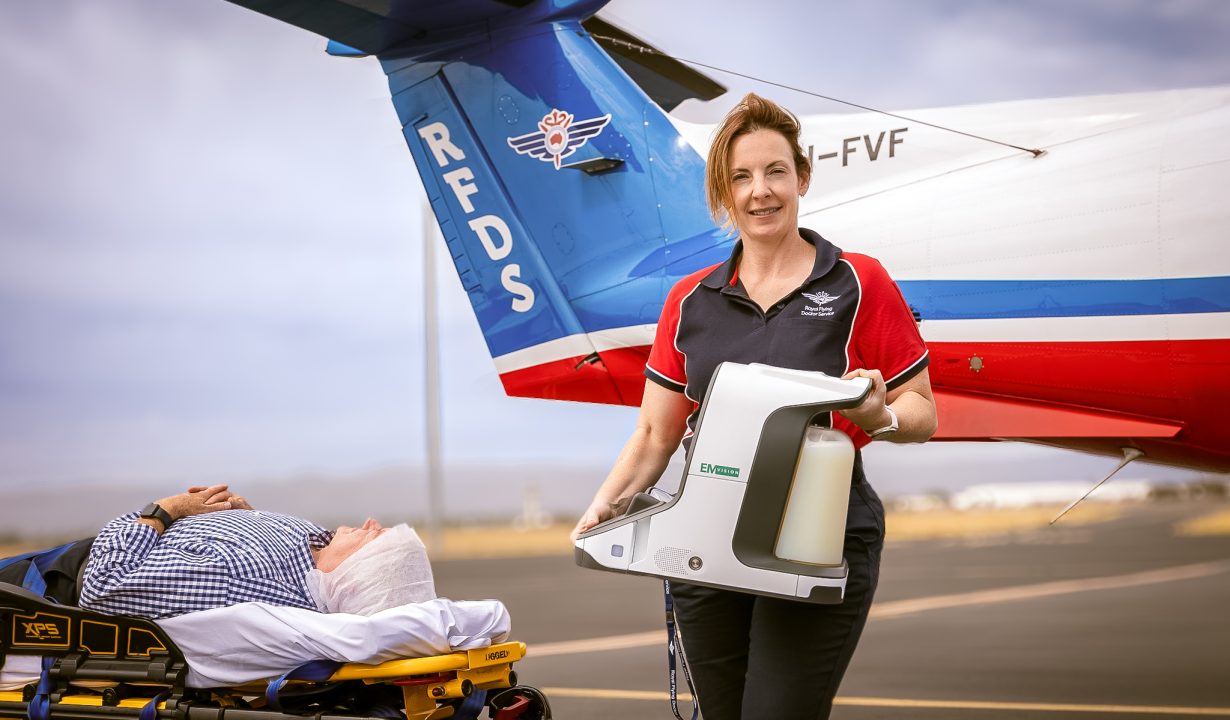
The First Responder scans patients on-site and communicates results to neurologists via telehealth. This enables paramedics to quickly identify the type of stroke or TBI a patient is experiencing – a crucial step for safe, effective triage and treatment.
Robert described the innovation as “empowering clinicians at the first point of care”. The advancement will prevent delays that can cost lives.
“Time is brain,” said Robert.
“The earlier we can intervene, the greater the chance of recovery – and the lighter the impact stroke has on patients, families, and society.”

The EMVision Research Team
The economic impact of strokes
Strokes have a devastating economic impact. Robert noted that in 2021 the annual cost of strokes was around US $891 billion globally, and this is projected to rise to US$1.6 trillion by 2050.
By reducing reliance on costly hospital imaging, First Responder minimises the burden on hospitals and health systems. The device itself is also significantly more affordable than existing solutions. MSUs cost up to US$1.7 million and require specialist crews, while First Responder costs approximately US$50,000 and can be operated by trained personnel.
“If you can treat the patient quickly, you reduce that burden profoundly,” Robert said.
“The EMVision First Responder takes that same principle [as the MSU] – bringing the scanner to the patient. But, it’s more affordable, lightweight, and deployable anywhere.”

The Governor-General of Australia presents the 2025 Michael Bryce Patron’s Award – First Responder
User needs as the golden standard
First Responder began as a University of Queensland research project and was commercialised by EMVision Medical Devices, which opened its Sydney head office in 2020. Over the years, the EMVision Design and Research Team led rigorous user research and testing. They ensured First Responder could integrate seamlessly into paramedics’ workflows.
Robert said user needs were treated as the ‘golden standard’ throughout the design process. The collaborative conceptual development process involved meeting paramedics ‘on their terms, in their environment’ and shadowing retrievals.
During the research process, Robert was amazed by paramedics’ skill and resilience.
“Even though [paramedics] will figure out how to use it and get around it, we were determined to make this seamless and as invisible to them as possible,” Robert shared.
While some needs changed across different states, one was constant. First Responder needed to be lightweight, fast, and easy to use. Robert said it was important that users didn’t need to think about how the kit works, explaining, “You just want to use it when the time comes.”
Balancing functionality and portability
The EMVision Design and Research Team overcame significant technical, ergonomic, and usability constraints when designing First Responder. Robert said miniaturising the technology was a response to user needs.
“We’ve done lots and lots of user research with paramedics, both road and air… to determine their workflows and how a scanner like this would fit,” he explained.
“Miniaturisation is really a result of needing to respond to ergonomics…patients needing to be scanned are not in the best of health if they’re suffering a stroke.”
The design journey was a balancing act between competing demands: power, performance, size, portability and speed.
“As soon as someone says, ‘I want it to run for an hour,’ that’s another kilo of batteries you have to put into the product.”
“It’s been quite a challenge to balance all the demands from different stakeholders to create something that ultimately ticks the boxes for everyone.”
The team also faced practical design challenges, like developing a flexible cap to fit a wide range of head sizes, avoiding wrinkles during liquid filling, and ensuring the device could operate reliably across road and air ambulance environments. Every decision had to maintain diagnostic accuracy, meet regulatory standards, and support paramedics’ workflow without compromise.
In the end, the EMVision Design and Research Team not only met their ambitious target weight of 12 kilograms, but also integrated proprietary antenna and signal analysis modules, along with a fluidics system. The innovation represents a significant milestone in portable, AI-driven diagnostics.
“When I started with the company eight years ago, that technology was the size of a small desktop computer… and we’ve now worked on a device that is the size of approximately half of a mobile phone.”
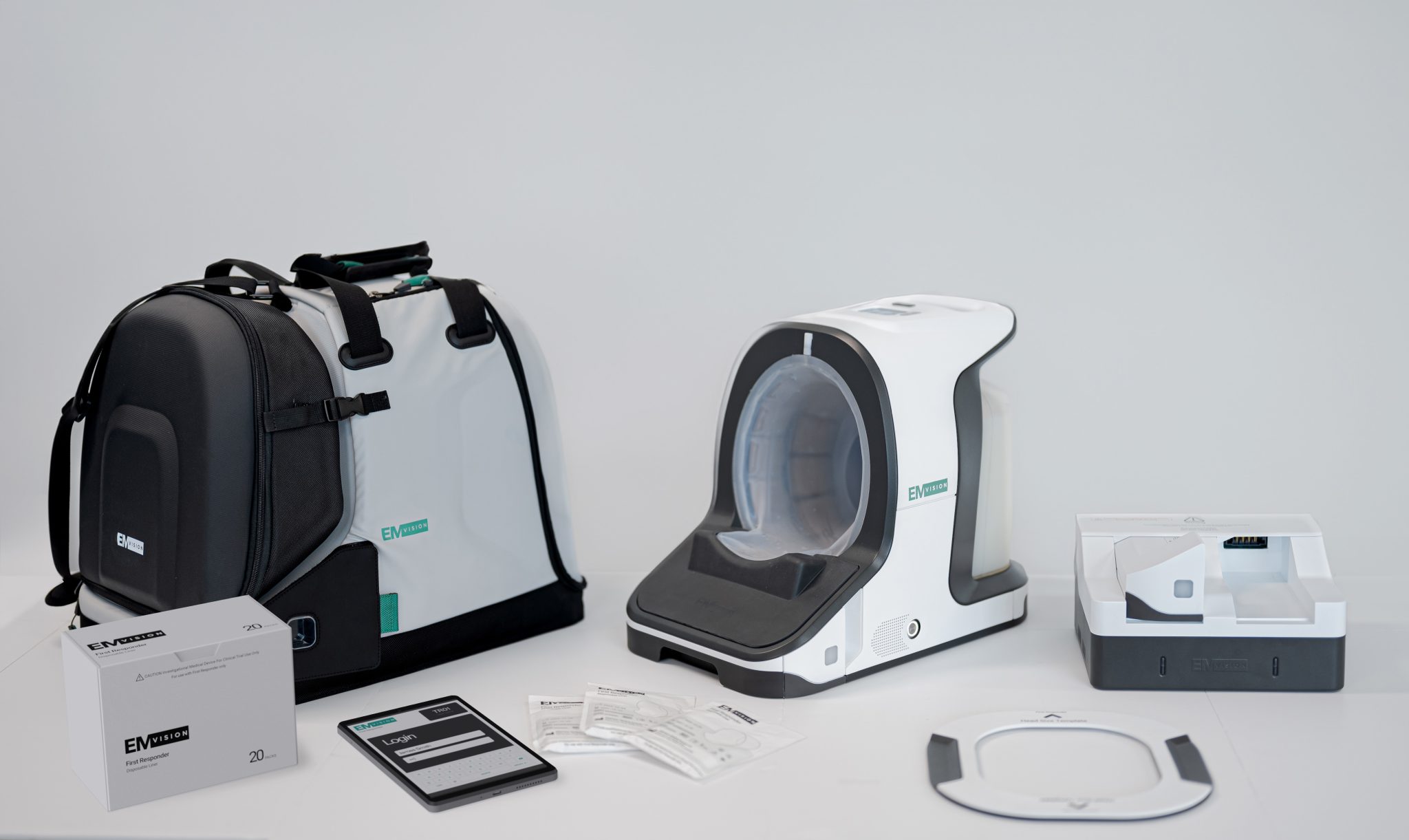
2025 Michael Bryce Patron’s Award – First Responder
Reaching remote and underserved communities
First Responder places life-saving stroke and TBI care within reach, offering advanced neurodiagnostic technology at an affordable price.
“Wherever you are – rural, regional, remote – you should get access,” explained Robert.
“First Responder is easy and safe to use. This empowers local clinics or practitioners to perform scans on-site.”
Additionally, integrated telehealth systems enable scan data to be shared instantly with specialists across the country.
“You could put one of our scanners anywhere…and action a code stroke immediately.”
By ‘decentralising big ticket equipment’, First Responder makes life-saving stroke and TBI care more accessible than ever.

The 2025 Australian Good Design Awards Ceremony, where 2025 Michael Bryce Patron’s Award – First Responder was announced
AI-driven diagnostics technology
First Responder uses a proprietary AI engine, which is trained on clinical data to deliver rapid neurodiagnostic analysis. The engine plays a crucial role in the device’s speed and output.
“Without AI, the computing and data processing power needed would be overwhelming to try and affect the same outcome,” Robert said.
With more than 35 years in the industry, Robert has seen firsthand how AI can elevate design and development, enabling levels of precision and efficiency that were once out of reach.
While he sees AI as a powerful tool, he believes the essence of good design still lies in human creativity and intuition, and in how humans guide AI.
“You can make [AI] do amazing things, but it’s only as good as what you ask it to do.”
“AI is the sum of what it can learn, how it learns, and how it’s been told to learn,” he explained. “In the creative industries, original thinking, the generation of new ideas, imagery, and models are critical. I do not think Ai will deliver true creativity.”
Describing himself as an old-school designer, he joked, “You can mark those words in 50 years, you’ll be able to say how ridiculously wrong I was.”
From concept to reality
For Robert personally, the most rewarding part of the project has been seeing the research evolve into a life-saving device.
“Reshaping and lifting that research out of a university laboratory, shaping the science into an application as profoundly important as stroke treatment and diagnosis, was very rewarding.
“It’s not often in your career that you get to work on something that is genuinely new,” he said. “This just didn’t exist 10 years ago…watching the transition from benchtop to product in an entirely new technology is very satisfying.”
Good Design Australia congratulates the EMVision Design and Research Team on their pursuit of excellence – in service of stroke and TBI patients, their communities, and Australia’s first responders.