2025 Automotive Exterior Design Commendation – Hyundai IONIQ 9
- Published on: 9 December 2025
Share
GOOD DESIGN AUSTRALIA’S AUTOMOTIVE DESIGN COMMENDATION IS A SPECIAL ACCOLADE WITHIN THE AUTOMOTIVE AND TRANSPORT CATEGORY THAT RECOGNISES EXCELLENCE IN AUTOMOTIVE DESIGN AND STYLING.
The Automotive Exterior Design Commendation celebrates vehicles that turn heads. In 2025, the spotlight falls on the Hyundai IONIQ 9, a three-row electric SUV designed for family life without compromise.
As the flagship of Hyundai’s award-winning EV range, the IONIQ 9 is a bold step towards the company’s vision of 21 electric vehicles by 2030. The brief demanded a revolutionary SUV that combines space, comfort, and performance, wrapped in a striking design and crafted with the customer in mind.
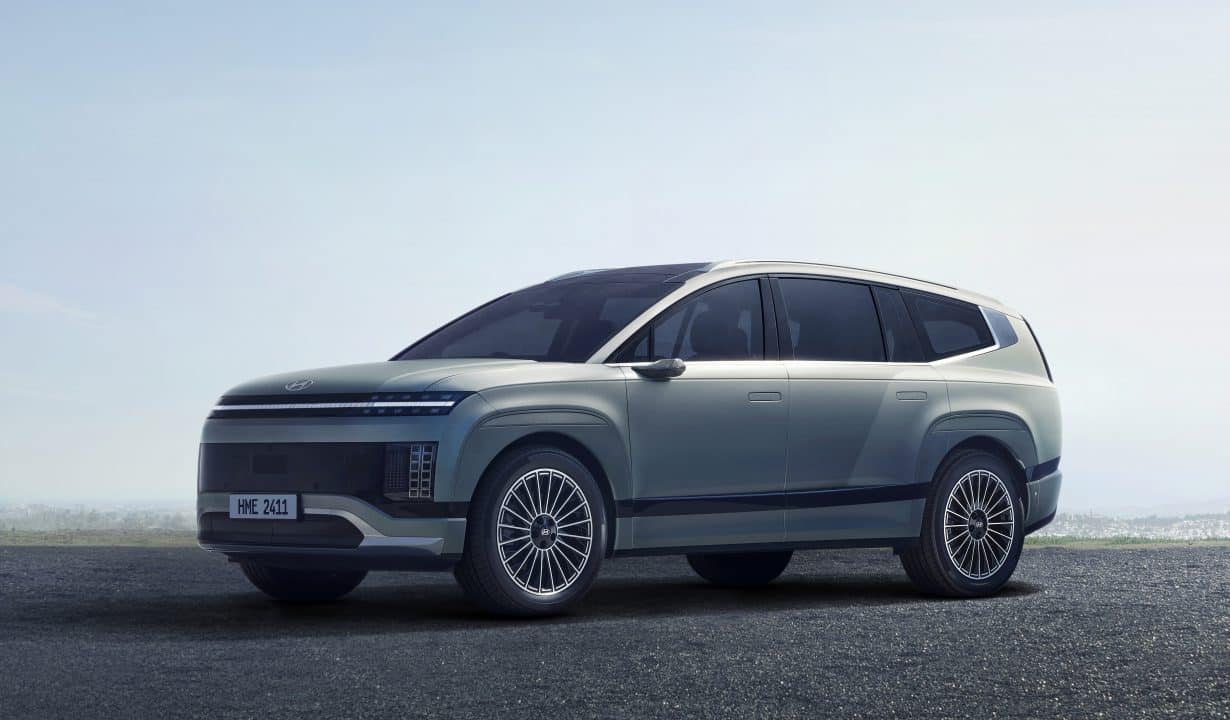
Simon Loasby, Senior Vice President and Head of Hyundai Design Center, guided us through the results. Its sleek, slippery silhouette exemplifies “aerosthetic,” a term coined by Hyundai to describe the fusion of aerodynamics and aesthetics.

Hyundai IONIQ 9 Exterior. Image: supplied
A new piece on the board
Hyundai set out to create an EV unlike anything seen before, shaped by how people use a vehicle and how they want it to look and feel.
“It was a collaborative effort across our organisation. A very strong virtual collaboration on how to create the most efficient shape and form,” said Simon.
“We wanted to do something unique for this generation of EVs, for people focused on efficiency, sustainability, and being in tune with nature.”
Nature played a central role. Diana Kloster and the colour team explored materials, human behaviour, and the environment to make the SUV both sustainable and efficient.
Simon explained that the IONIQ 9 rests on three pillars: sustainability, furnished space, and Parametric Pixels.
That look follows Hyundai’s “chess-piece” philosophy, ensuring each vehicle is distinct yet cohesive.
“IONIQ 9 is one of our chess pieces. Its silhouette is unique, and each model has a different move on the board, but together they form a cohesive group through design details like Parametric pixel lighting,” Simon said.
A defining feature is Hyundai’s Parametric Pixel, a futuristic-retro motif of geometric pixels across the front and rear. It unites all IONIQ vehicles and gives the SUV a striking, unmistakable identity.
“The base in IONIQ for us, the visual base, is the Parametric Pixel, which connects all of our electric cars,” Simon added.

Hyundai IONIQ 9 front. Image: supplied
Electric elegance
Building on its signature visual language, the IONIQ 9 exemplifies electric elegance. Its sleek ‘aerosthetic’ exterior fuses cutting-edge design with advanced electric vehicle technology, reflecting Hyundai’s commitment to aerodynamic efficiency and futuristic styling. A tapering boat-tail not only enhances airflow but also defines the vehicle’s distinctive silhouette.
“It’s a hugely aesthetic form, but we didn’t want complexity. We wanted a simple, puristic form,” Simon explained.
The Hyundai IONIQ 9 turns aerodynamics into art. Its seamless silhouette sweeps from hood to tail, embodying “aerosthetic”.
The exterior shapes the interior too. Shortening the hood, angling the windscreen, and positioning the roofline over the second row creates a spacious, airy cabin. Even the third row enjoys clever proportions, offering more room than the exterior suggests.
“The cabin length, from the rear separation edge to the bottom of the cowl, is much bigger than anything we’ve ever produced. That gives us the overall architecture inside,” Simon said.
Sustainability guided every decision.
“The black cladding on the exterior is actually from recycled tyres. The pigment comes from old car tyres that are ground up, creating a black pigment. That’s a wonderful way of reusing waste,” Simon added.
This vision first appeared in the SEVEN Concept, showcased in LA, with its lounge-like interior and circular design principles that directly shaped the IONIQ 9.
“We stacked IONIQ 9 with the most sustainable content we could and created the most efficient SUV,” Simon added.
Every curve and edge was carefully sculpted to minimise drag, creating a design that’s as efficient as it is striking.
“Aerodynamically, we’re down to a drag coefficient of 0.259, slightly lower than that of our Sonata ICE sedan, but achieved for a full three-row SUV. That means you use less energy, charge less, and lose less time charging,” he explained.
To achieve this balance of efficiency and style, the team relied on a guiding framework that ensured every design decision supported the vehicle’s overarching vision: the design priority pyramid.

Hyundai IONIQ 9. Image: supplied.
Designing with clarity
Woo-hyun Lee and Hyeong-soo Lee from Hyundai’s Exterior Design Team credited the design priority pyramid as one of the frameworks Simon brought to the project that shaped the vehicle’s design.
At the top of the pyramid is the “aerosthetic lounge,” said Simon. “The top portion is the three-second answer. Bump into your editor-in-chief, and you say, ‘That’s our aerosthetic lounge. It’s aerodynamic, beautifully aesthetic, and it’s a lounge space’.
This hierarchy keeps the team aligned, captures the car’s essence in seconds, and ensures every choice supports the top-level vision.
It allows the team to expand on key attributes like proportion and seating layout without losing focus. It guides every project, from full vehicles to interiors and even steering wheel redesigns, keeping priorities clear and design intentional.

Hyundai IONIQ 9 Lounge. Image: Supplied
Customer-centric design
For Simon, great design starts with the customer. The IONIQ 9 was guided by a customer-centric approach. The team was challenged to understand how people live, use and experience their cars, then solve the problems they might not even articulate.
“Good design isn’t about styling for the sake of it. It’s about understanding the customer’s perspective, their lifestyle”, he explained.
“We don’t just sit and sketch. We follow the journey our customers take. Watching people shows you what really frustrates them and where things can be improved.”
This philosophy is evident in the vehicle’s smallest details. Simon pointed to the cup holder as an example.
“One of my biggest frustrations in cars is trying to get a coin out of the cup holder. It’s a universal annoyance. “In our Palisade, or any of our cars since, it’s now the easiest cup holder to get a coin out of. It’s a small detail, but it reflects our design mindset and how we solve hidden problems through design.”
The same approach shapes bigger design decisions, referencing the iterative process to perfect the vehicle’s proportions and silhouette.
“To achieve the aerodynamic efficiency we wanted, we had to adjust the vehicle’s height. It’s about collaboration, debate, and looking at the big picture. That process created a more efficient and distinctive profile that works for customers every day,” Simon said.

A statement in motion
The IONIQ 9 embodies what’s possible when designers speak up, challenge ideas, and work together to find the best solutions.
“It’s a collaboration. It’s open to ideas from anywhere. Everybody speaks up, shares points, asks questions, and keeps asking until you get a solution you can accept,” Simon explained, emphasising curiosity and questioning assumptions.
“It’s a bit of an ‘I’ mindset, like a five-year-old asking ’why’ over and over until you find a solution you can accept,” he added.
Even seemingly fixed targets, like the car’s height, were open to debate as the team kept asking, ‘Why?’
Early on, they realised that sticking to the original numbers would compromise aerodynamics. Through discussion, questioning, and weighing all inputs, they decided to raise the roofline, creating a more efficient and distinctive profile. It’s a clear example of how collaboration, curiosity, and accountability drive the best design outcomes.
By aligning exterior and interior design and focusing on the priorities set out in the design pyramid, Hyundai crafted a car where function and beauty are inseparable.
The IONIQ 9 combines sustainability, human needs, and visual impact. It’s striking in style yet practical in performance, with every detail serving customers and reinforcing brand identity.
Good Design Australia congratulates Hyundai for reimagining what’s possible in automotive design.